


Homegrown products are steadily carving out a place in international markets, as government-backed certification initiatives continue to elevate their visibility and credibility among premium buyers.
A fresh round of recognitions under the Bhutan SEAL Award and Brand Bhutan Certification has highlighted the country’s diverse range of artisanal and agricultural products—from finely crafted silk textiles to herbal teas and pristine mountain spring water. The initiatives, aimed at strengthening market linkages and promoting high-quality local goods, are increasingly opening doors to global trade opportunities.
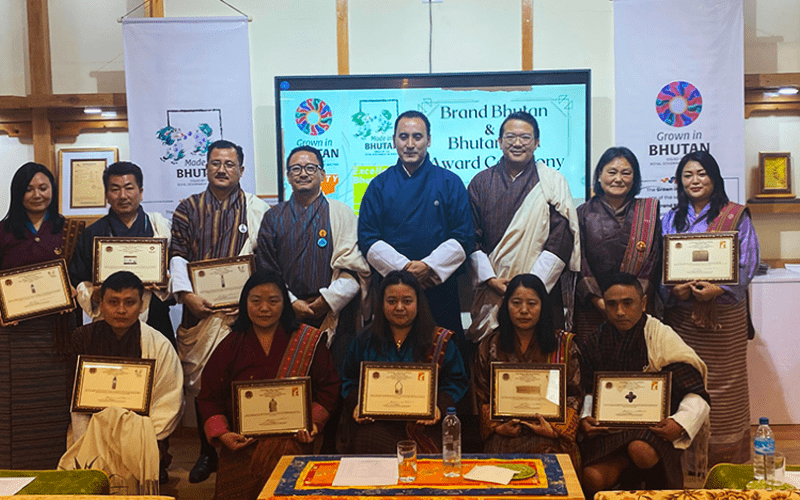
Seven standout products were conferred the Bhutan SEAL Award, each receiving a cash prize of Nu 25,000. The award, which celebrates excellence in craftsmanship and authenticity, went to items such as Dorji Jadram Neycha produced by Druk Bronze Casting Works, a raw silk shawl from Damchoo’s Collection, and nettle-based creations by Tarayana Rural Crafts and Green Craft Bhutan. The selection process rigorously evaluates products on their artistry, cultural integrity, and overall quality.
In parallel, 12 products earned the Brand Bhutan Certification under the “Made in Bhutan” and “Grown in Bhutan” labels. This certification focuses on verifying origin, maintaining high production standards, and ensuring environmentally sustainable and ethical practices.
Among the certified items, Himalayan Gooseberry Tea by Menjong Sorig Pharmaceuticals Corporation Limited stood out in the “Grown in Bhutan” category. Meanwhile, Green Craft Bhutan secured three certifications for its Chemla shawl, Block Jacket, and Trima Jacket—an achievement its founder, Karma Choden, described as a major boost for product visibility and market reach.
Bhutan Agro also received three certifications for its premium mountain spring water, while Tarayana Rural Crafts earned five recognitions for its innovative nettle-based products. According to Bhutan Agro’s CEO Sherub Namgay, meeting certification standards requires robust systems and strict quality control—factors that ultimately strengthen product reliability.
Officials say these recognitions are more than symbolic. By linking producers to international trade fairs, exhibitions, and export platforms, the certifications provide tangible pathways to new markets. They also serve as a mark of trust for global consumers, assuring quality and authenticity—key factors that allow Bhutanese goods to command premium prices.
As reported in local Bhutan news websites, industry leaders emphasize that Bhutan’s competitive edge lies not in mass production but in value-driven offerings. “We may not compete in scale, but we must stand out in quality,” said Minister for Industry, Commerce and Employment Namgyay Dorji, noting that Bhutanese products are well-positioned to attract value-based pricing in global markets.
Since its inception in 2016, the Brand Bhutan initiative has certified more than 100 products, while the Bhutan SEAL Award—introduced in 2009—has recognised over 120 items. This year alone, nearly 80 participants took part in the certification process.
Beyond boosting exports, officials believe the initiative will also raise domestic awareness and encourage consumers to support locally made goods. With plans to expand the programme further, the Department of Trade aims to strengthen Bhutan’s footprint in regional and international markets while empowering local producers to thrive on a global stage.


