


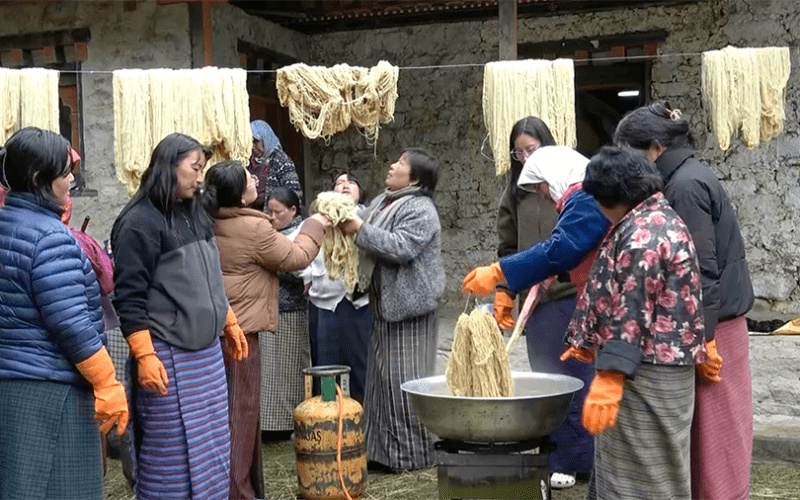
In the picturesque Chhumey Valley of Bumthang, efforts are underway to revive a traditional craft that has long been intertwined with the region’s cultural identity. As sheep rearing continues to decline, a centuries-old practice of naturally dyeing wool—once central to the production of the famed Bumthap Yathra textiles—has been steadily fading. However, a new initiative is helping local women reclaim and preserve this heritage.
For generations, Yathra weaving has been a cornerstone of life in Chhumey Gewog. Known for its distinctive patterns and vibrant colours, the textile was traditionally crafted using wool dyed with pigments extracted from local plants. Among the most commonly used materials is mugwort, a native plant that provides natural colouring for wool.
Over time, changing lifestyles, reduced sheep populations, and shifts in textile production methods led many weavers to abandon natural dyeing practices. The loss of sheep rearing not only affected livelihoods but also weakened the connection to traditional methods that gave Yathra its unique character.
Recognising the need to preserve this cultural legacy, the Department of Media, Creative Industry and Intellectual Property (DoMCIIP) recently organised a training programme on natural wool dyeing for around 30 women weavers from Chhumey Gewog.
Participants say the training offers an opportunity to reconnect with ancestral knowledge and ensure its survival for future generations.
“The production of Bumthap Yathra has sustained our community for many years, and it continues to be an important source of income,” said Jangchu Dema, a resident of Chhumey Gewog. “We have grown up practising this craft and want to keep it alive. With proper training, we can continue the tradition and pass these skills on to our children.”
The programme is also opening new possibilities beyond Yathra production. According to participant Chonga Lhamo, learning natural dyeing techniques could allow weavers to diversify their products and supply naturally coloured yarns for other textile artisans.
“If we understand the dyeing process well, we can apply it to different types of yarn, not just those used for Yathra,” she said. “This creates opportunities to expand production and support other weavers.”
Beyond preserving traditional knowledge, the initiative is linked to broader efforts to secure Geographical Indication (GI) certification for naturally dyed Yathra produced in Chhumey. GI certification serves as an official recognition of a product’s origin, authenticity, and quality, helping distinguish it in domestic and international markets.
According to DoMCIIP Director Sonam Penjor, promoting GI-based products can deliver both cultural and economic benefits to local communities.
“Our focus is to empower communities through products linked to geographical indications,” he said. “Such initiatives help safeguard traditions and cultural heritage while creating new opportunities for economic growth and community development.”
As interest in sustainable and authentic handcrafted products grows, the revival of natural dyeing in Chhumey offers hope for both cultural preservation and rural livelihoods. For the women weavers of Bumthang, it represents more than a return to traditional methods—it is a step toward ensuring that the rich legacy of Yathra weaving continues to thrive in the years ahead.


