


Across several gewogs in Monggar, fields once dominated by maize and other traditional crops are gradually giving way to pineapple plantations and mango orchards. For many farmers, the shift is being driven not merely by the prospect of better earnings, but by something equally important—certainty that their harvest will be sold.
At the centre of this transition is the Bhutan Agro Industries Limited processing plant in Lingmithang, which purchases fruits directly from growers for the production of juices, jams and pickles. With mangoes, pineapples and passion fruits currently in peak season, the plant has become a busy collection point for farmers arriving with truckloads of fresh produce.
Recently, members of the Yangbari Pineapple Group delivered three Bolero truckloads of pineapple to the facility. The company pays approximately Nu 44 per kilogramme. After accounting for transportation and labour expenses, farmers earn about Nu 37 per kilogramme.
Produce certified as organic receives an additional payment of Nu 2.5 per kilogramme, an incentive intended to encourage growers to adopt organic farming practices.
Farmers can sometimes obtain higher prices by selling directly in markets such as Lingmithang and Gyalpozhing, where an individual pineapple may fetch around Nu 50. Yet many prefer selling to the processing company because it accepts large quantities and removes the uncertainty of searching for customers.
For growers dealing with highly perishable produce, a dependable bulk buyer can make the difference between profit and loss.
“Since we partnered with Bhutan Agro Industries, we have not faced any difficulty selling our produce,” said Norbu Wangdi, a member of the Yangbari Pineapple Group.
He said farmers coordinate with company officials during the busy harvesting period and deliver their produce according to the plant’s requirements, helping avoid congestion and inconvenience.
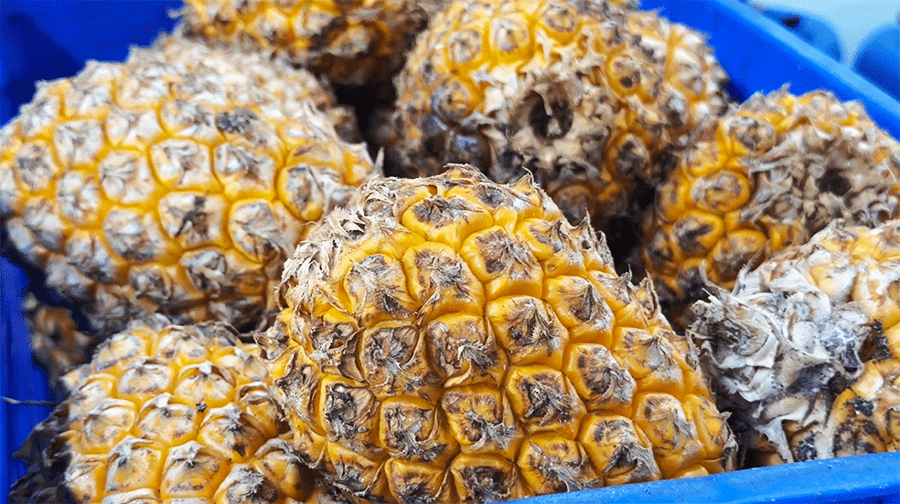
The impact of the assured market is reflected in Monggar’s production figures. Pineapple output, concentrated mainly in Gongdue and Thangrong Gewogs, rose from about 14 metric tonnes in 2024 to more than 60 metric tonnes in 2025.
Mango cultivation has recorded similar growth. Production increased from approximately 87 metric tonnes in 2024 to more than 110 metric tonnes last year.
The expansion has also been supported by the district agriculture sector, which distributed more than 20,000 mango saplings across 17 gewogs between 2022 and 2025.
Although mangoes can command around Nu 100 per kilogramme in local markets, compared with slightly more than Nu 50 at the processing plant, farmers say selling directly to the company is often more practical. The facility can purchase entire harvests at once, reducing the possibility of fruits rotting before they reach consumers.
“Manpower becomes a major challenge during the harvesting season,” said Lhawang Norbu, a mango grower from Khalangzi in Monggar. “Once the mangoes ripen, they can spoil within a day or two. We have to work against time. Here, we can sell in bulk, which makes the company a reliable buyer.”
Bhutan Agro Industries Limited currently purchases oranges, mangoes, strawberries and passion fruits, in addition to pineapples. Since beginning operations in 2019, the company has partnered with around 200 farmers’ groups cultivating roughly 200 acres of farmland, primarily in eastern Bhutan.
Beyond purchasing produce, the company provides technical support to improve farm management and productivity.
Bhutan Agro Industries Limited CEO Sherab Namgay said close cooperation with growers would become increasingly important as the company expands its range of products.
“Bhutan Agro has been a reliable partner for our farmers, and it is a win-win arrangement,” he said. “We are working on premium products for the domestic and export markets, including products for Gelephu Mindfulness City.”
He said the company is focusing on juices, jams, pickles and water-based products. A regular and adequate supply of raw materials from farmers’ groups will therefore be essential to its growth.
Agriculture officials attribute Monggar’s rising fruit production to a combination of assured market access, improved planting materials and sustained technical assistance. Saplings supplied through the Million Fruit Tree Plantation initiative have also helped farmers establish and expand orchards.
Growers receive additional support from the Agriculture Research and Development Centre in Wengkhar and gewog extension officers, who advise them on orchard management, disease control and methods of increasing yields.
The emerging partnership between farmers, agriculture officials and the processing industry is gradually reshaping farming in Monggar. By linking production directly to processing and markets, it has reduced one of the greatest risks faced by rural growers—the possibility of harvesting a good crop but finding no one to buy it.
For Monggar’s fruit farmers, the confidence to expand cultivation is increasingly rooted in a simple assurance: when the fruits are ready, a market is waiting.


