


Nearly half a billion people moved above the World Bank’s lower-middle-income poverty threshold between 2011 and 2023, marking a major shift in the region’s development landscape.
India has recorded one of the most significant poverty reduction achievements globally over the past decade, highlighting the country’s changing socioeconomic landscape and carrying wider implications for development across South Asia.
According to the World Bank’s October 2026 Poverty and Equity Brief, an estimated 496 million Indians moved above the poverty threshold applicable to lower-middle-income economies between 2011 and 2023.
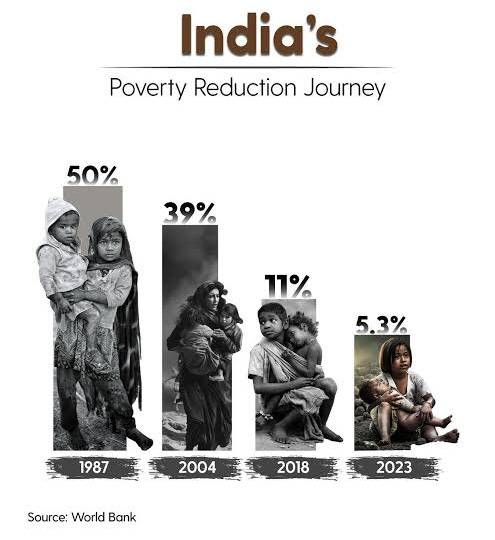
The proportion of India’s population living below this threshold, defined as USD 4.20 per person per day in 2021 purchasing power parity terms, declined from 57.7 percent to 16.1 percent during the period.
The reduction of 41.6 percentage points represents a substantial transformation in a country that accounts for nearly one-sixth of the global population. The World Bank also documented progress in reducing extreme poverty and deprivation across non-monetary dimensions.
Moving beyond income-based development
India’s development experience brings renewed attention to the importance of addressing poverty through multiple channels rather than relying exclusively on economic growth.
Investment in physical infrastructure, financial inclusion, digital public services, sanitation, healthcare, electricity access and social protection can help translate aggregate economic progress into tangible improvements in household welfare.
India’s extensive digital public infrastructure has also demonstrated how technology can expand the reach of public services. The integration of digital identification, banking services and electronic payments has created mechanisms through which governments can deliver welfare assistance more directly.
The effectiveness of such systems ultimately depends on accessibility, institutional capacity and their ability to reach economically vulnerable populations.
Implications for Bhutan and the wider neighbourhood
India’s socioeconomic transformation holds particular relevance for neighbouring countries seeking to balance economic expansion with equitable development.
Bhutan has registered considerable progress in poverty alleviation. According to a World Bank assessment released in May 2025, the kingdom’s poverty rate declined from 28 percent in 2017 to 11.6 percent in 2022.
Nevertheless, rural communities remain disproportionately vulnerable, accounting for approximately 87 percent of the country’s poor population. Employment generation, economic diversification and climate resilience remain critical to maintaining these gains.
While differences in population, geography and economic structures require country-specific approaches, India’s experience offers opportunities for regional knowledge exchange in areas such as digital governance, financial inclusion, infrastructure development and targeted welfare delivery.
Greater regional cooperation could enable South Asian economies to benefit from technological innovation, institutional expertise and expanding markets while developing solutions suited to their respective national circumstances.
The next frontier of inclusive growth
Despite India’s substantial progress, crossing an internationally defined poverty threshold does not necessarily guarantee long-term economic security. Households that have recently escaped poverty may remain vulnerable to unemployment, inflation, health emergencies and climate-related disruptions.
The next phase of development will therefore require sustained attention to productive employment, education, skills development and economic resilience.
For South Asia, India’s achievement is significant not only because of the scale of poverty reduction but also because it illustrates the possibility of improving living standards across exceptionally large populations.
The region’s future developmental success will depend on transforming these gains into lasting economic security, greater social mobility and equitable opportunities for subsequent generations.


