


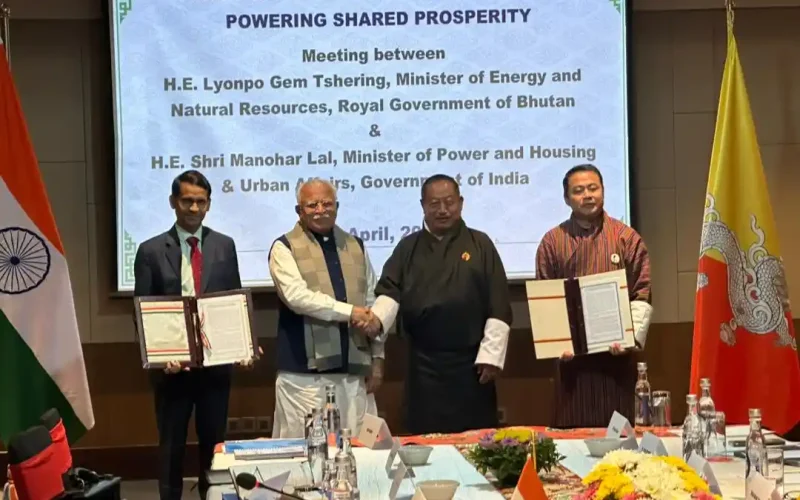
Bhutan further advanced its position as a regional clean energy leader following the successful official visit of Manohar Lal, India’s Minister for Power, Housing and Urban Affairs, from April 9 to 12. The visit, hosted by Gem Tshering, Bhutan’s Minister for Energy and Natural Resources, delivered tangible outcomes that are expected to generate long-term economic and technical benefits for the Kingdom.
A major highlight of the visit was the first concrete pour ceremony at the 1200 MW Punatsangchhu-I Hydroelectric Project on April 10. The milestone marked the formal start of dam construction, bringing renewed momentum to one of Bhutan’s most important hydropower investments. Once completed, the project is expected to significantly boost Bhutan’s electricity generation capacity, strengthen domestic energy security, and increase export revenues.
Bhutan also secured further economic gains through the signing of a protocol on the export tariff for the 1020 MW Punatsangchhu-II Hydroelectric Project in Thimphu on April 9. The project, inaugurated in 2025 by His Majesty Jigme Khesar Namgyel Wangchuck and India’s Prime Minister Narendra Modi, had already begun exporting surplus electricity to India. The agreed tariff framework ensured predictable and sustained revenue streams for Bhutan, reinforcing hydropower as a cornerstone of the national economy.
In another important development, Bhutan and India finalized a methodology for accounting reactive power exchange, to take effect from May 1, 2026. This technical arrangement is expected to improve grid stability within Bhutan, reduce transmission inefficiencies, and ensure fair compensation for power flows—further optimizing the country’s energy exports.
Officials emphasized that these developments strengthened Bhutan’s energy sector not only in terms of infrastructure, but also in institutional capacity and technical expertise. The agreements enhanced cross-border transmission reliability, opened avenues for advanced training and collaboration, and supported Bhutan’s broader goals of sustainable development.
The visit reaffirmed the enduring partnership between Bhutan and India, built on trust and mutual benefit. More importantly, it underscored Bhutan’s growing role as a clean energy exporter, with hydropower continuing to drive economic growth, generate employment, and contribute to national prosperity.


