


Bhutan is set to make another stride in space technology as two Bhutanese students travel to Japan to work on a joint satellite project with Chiba Institute of Technology. The satellite, scheduled for launch next year, is part of a five-year collaboration between Bhutan’s GovTech Agency and the Japanese institute, aimed at boosting satellite research and nurturing local expertise.
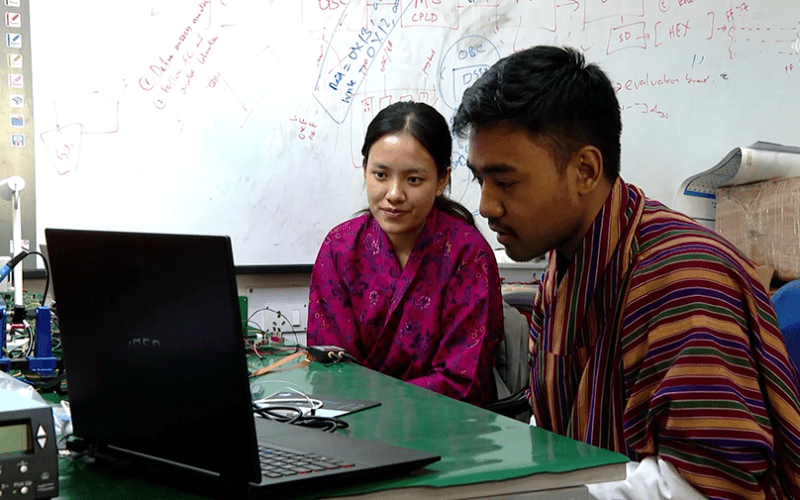
Diwas Pradhan and Sonam Yangzom, both 22-year-old students from the College of Science and Technology (CST) under the Royal University of Bhutan, will spend the next ten days in Japan integrating a Bhutanese-developed payload into the Japanese-built satellite.
The payload, designed over the past six months by a team of five CST students and one student from Sherubtse College, carries three primary missions: capturing images of Earth, monitoring ozone health, and conducting magnetic field studies from space.
“We are basically going to integrate the payload that we developed with the Japanese satellite,” said Diwas Pradhan, the team leader. “This will allow us to not only observe Earth but also contribute valuable data on ozone and magnetic activity.”
The journey began last year when GovTech conducted a satellite workshop at CST, where students competed through brainstorming sessions and presentations. The top-ranked team earned the opportunity to work with Chiba Tech.
“For most of us, this was our first exposure to satellite technology,” said Sonam Yangzom. “We started from scratch, but after seven months of hard work, we now understand how satellites communicate and operate.”
The collaboration is already being hailed as a landmark step for Bhutan. Jigme Tenzing, Secretary of GovTech, described it as “a historic opportunity for Bhutanese students to work end-to-end on satellite development,” adding that future batches of students will continue to design new payloads every year under the MoU.
He further emphasized the broader vision: “This initiative is not just about technology; it’s about inspiring our youth to pursue STEM fields and contribute to His Majesty’s vision of developing Bhutan’s capabilities in space technology.”
The students involved in the project may also be recruited by GovTech for future satellite missions, laying the groundwork for Bhutan to eventually build its own commercial satellites.
As the two young engineers begin their work in Japan, they carry not only scientific curiosity but also the hopes of a nation taking its first determined steps into outer space.