


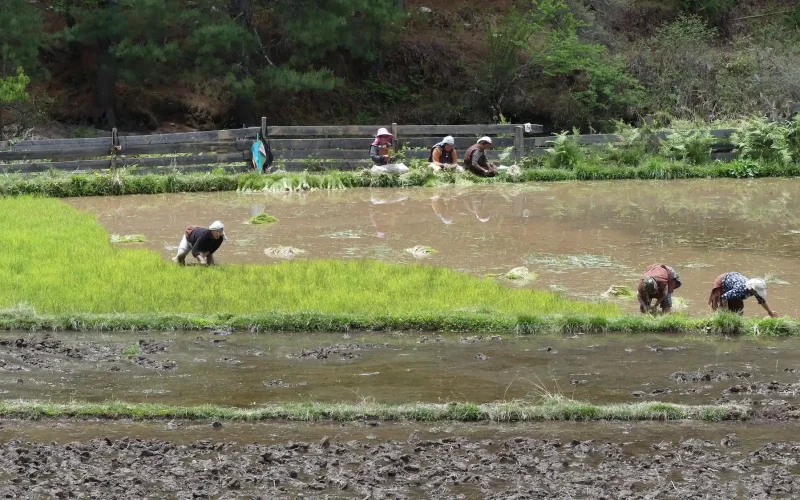
Nearly a year after its formal launch, Bhutan’s AgriSustain Fund (BAF) — a bold USD 80 million catalytic financing platform — remains in the early stages of mobilisation. With only a USD 2 million pledge from the Asian Development Bank secured so far, the gap between Bhutan’s transformative agricultural ambitions and financial reality is stark. This is more than a funding shortfall; it is a litmus test for whether small, landlocked nations with extraordinary environmental commitments can attract the patient capital needed to build climate-resilient food systems.
Launched in partnership with the FAO and backed by Bhutan’s policy architecture — including the Food and Nutrition Policy 2023, Climate Change Policy 2020, and Forest and Nature Conservation Act 2023 — the fund targets five strategic pillars: climate-smart practices for smallholders, biodiversity and ecosystem resilience, inclusive value chains, digital transformation, and skill development. The long-term vision is ambitious: by 2034, over 30% of Bhutanese farms should be climate-resilient, mechanised, and digitally enabled, with deeper structural shifts targeted by 2050.
This is classic Gross National Happiness (GNH) in action — prioritising ecological balance, inclusivity, and long-term resilience over short-term yields. Bhutan’s agriculture, which supports the majority of its rural population, faces familiar Himalayan challenges: fragmented smallholdings, human-wildlife conflict, climate vulnerability, and limited market access. The fund rightly positions blended finance and private investment as essential tools to de-risk these areas and unlock productivity.
Yet the slow mobilisation highlights a perennial problem in sustainable development finance. Philanthropists and impact investors love the narrative — carbon-negative Bhutan, organic ambitions, and alignment with global goals like the UN’s Hand-in-Hand Initiative. But translating narrative into committed capital requires more than compelling prospectuses. It demands clear pipelines of investable projects, robust governance, measurable returns (financial and impact), and derisking mechanisms that make sense for private actors wary of frontier-market risks.
The involvement of institutions like the Bhutan Development Bank for on-the-ground disbursement and the World Bank for institutional strengthening is encouraging. But as one ADB voice noted, fragmented investments risk inefficiency; integrated, collaborative structures are vital.
For India and the broader region, Bhutan’s experiment matters. As climate change intensifies pressures on Himalayan ecosystems and food security, scalable models of sustainable agrifood transformation are urgently needed. Bhutan’s focus on biodiversity, human-wildlife coexistence, and nutrition (complementing initiatives like One Child, One Egg) offers lessons — and potential collaboration opportunities — for neighbouring states grappling with similar issues.
The real test lies ahead. Can Bhutan move from policy ambition to a functional fund that delivers capital to family farms while preserving its unique development philosophy? Success would demonstrate that patient, values-driven finance can work in one of the world’s most ecologically sensitive regions. Failure, or prolonged stagnation, would reinforce scepticism about the gap between green rhetoric and investable reality.
Bhutan has the vision and the policy backbone. What it needs now is accelerated mobilisation — through innovative blended finance structures, stronger investor roadshows, and perhaps greater regional partnerships. The world, particularly climate-conscious investors and neighbours invested in Himalayan stability, should be watching closely and, ideally, contributing more than applause. An USD 80 million fund may seem modest globally, but its success could punch far above its weight in proving that sustainable agriculture in fragile ecosystems is not just desirable — it is fundable.
The clock is ticking on both climate resilience and rural livelihoods. Bhutan cannot afford for this fund to remain an ambition in perpetuity.


