


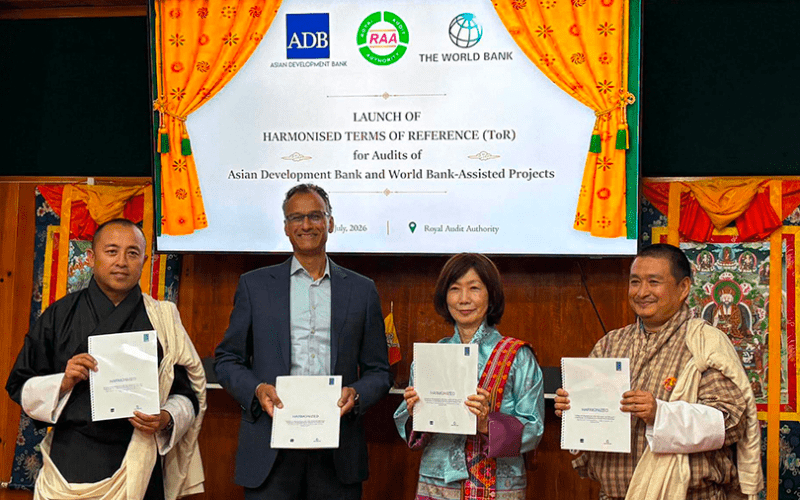
Development projects financed by the Asian Development Bank and the World Bank will soon be audited under a unified set of standards, following the launch of a common audit framework aimed at improving efficiency, consistency and accountability.
The Royal Audit Authority, working in partnership with the two international development institutions, launched the Harmonised Terms of Reference today. The framework is designed to streamline the auditing of externally funded projects by replacing separate requirements with a single, coordinated approach.
Previously, auditors were required to follow different procedures, reporting formats and compliance standards depending on which institution financed a project. An ADB-funded road project, for example, would be audited according to ADB guidelines, while a school or health facility supported by the World Bank would be assessed under a different set of requirements.
The new framework brings the key audit conditions of both institutions into one document, allowing auditors to assess projects using a consistent process while continuing to meet the expectations of each development partner.
Dorji Wangchuk, Joint Auditor General of the Royal Audit Authority, said the harmonised framework identifies the areas auditors must examine, the minimum standards they must follow and the information that must be included in their reports.
“Both the ADB and the World Bank have specific requirements that need to be fulfilled,” he said. “The Terms of Reference combine those requirements and provide auditors with clear guidance on the areas to review, the minimum procedures to carry out and the matters to report.”
He said the approach would enable the authority to meet the requirements of both institutions while raising the overall quality of audit reports.
The initiative is also expected to reduce repetitive work for project implementing agencies, which previously had to respond to separate audit processes. For auditors, the framework provides clearer instructions and a standardised reporting structure.
The reform comes as audit interventions continue to play an important role in safeguarding public resources. According to the Royal Audit Authority’s Annual Performance Report for the 2024–2025 financial year, audit findings contributed to the recovery or saving of Nu 184.458 million in public funds.
The amount included Nu 6.325 million refunded directly to the Asian Development Bank after auditors found that funds had been incorrectly claimed or paid under an ADB-supported project.
Dorji Wangchuk said greater consistency in auditing would provide stronger assurance to development partners that their financial resources were being used appropriately.
“The revised Harmonised Terms of Reference will ensure consistency in the audit approach and help address minimum reporting requirements,” he said. “It will provide better assurance to donors, strengthen transparency and accountability in public spending, and improve the quality of auditing.”
The framework is expected to benefit all parties involved in development financing. Implementing agencies will face fewer administrative requirements, auditors will work with more precise guidance, and development partners will receive more consistent assessments of how their funds are managed.
For the public, the common framework is expected to provide greater confidence that money allocated for development projects is being used responsibly and subjected to effective oversight.
The Harmonised Terms of Reference are expected to come into effect within the current fiscal year.


