

The passing of Zimpon Dorji Gyeltshen on July 14 marked the end of an era. His life, which spanned six decades of service under three monarchs, was not just the story of one man—it was the story of Bhutan itself. From a barefoot boy walking to Thimphu in search of justice to a trusted confidant of kings, Dorji Gyeltshen’s journey mirrored Bhutan’s transformation from an isolated kingdom to a modern nation guided by timeless values.
Born in 1942 into the noble house of Dhuezhi Chuem in Paro, Dorji Gyeltshen’s early years were shaped by hardship. Once among the valley’s most respected families, his household faced a steep fall from grace, culminating in the state seizing their manor and lands. Reduced to poverty, he and his mother laboured for daily wages, often struggling to secure two meals a day. Reflecting on that time, he recalled walking barefoot to Thimphu with his mother to receive partial compensation for their lost estate—an injustice that left a deep mark on him.
From Labourer to Soldier
At 17, Dorji Gyeltshen joined thousands of Bhutanese in building the nation’s first motorable roads. With Bhutan cautiously opening to the outside world, he soon enlisted in the army during a period of heightened border tensions. He was among only three young men from his village to serve, earning a modest salary of thirty rupees. His discipline and commitment would change his life forever.
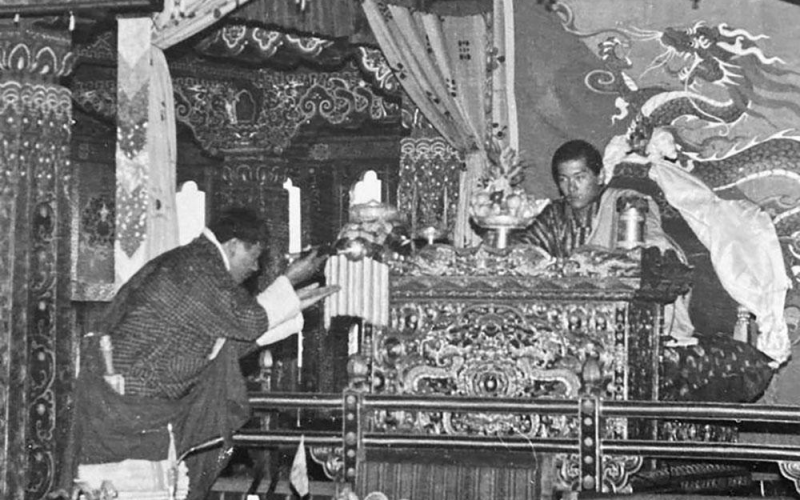
In 1963, he was handpicked to serve the eight-year-old Crown Prince Jigme Singye Wangchuck. Over six years, Dorji Gyeltshen became not just a bodyguard but a trusted companion to the young prince, fulfilling roles as varied as hunter, cook, and caretaker of royal dogs. His loyalty shone brightest in 1970 when the Crown Prince suffered a serious car accident in Assam—Dorji Gyeltshen stayed by his bedside day and night, supporting the anxious Third King throughout the ordeal.
Becoming Zimpon
On May 14, 1972, the Third King summoned Dorji Gyeltshen and entrusted him with a role that would define his legacy: Trongsa Zimpon. Despite his initial protest, citing his lack of education, the King insisted: “I trust you with my son. You must serve him with dedication.”
Two months later, after the Third King’s passing, Dorji Gyeltshen was appointed Gyalpoi Zimpon to His Majesty Jigme Singye Wangchuck, now the Fourth King. For 34 years, he became the crucial bridge between the monarch and the people, overseeing the office where citizens could directly appeal to the King.
Guided by the Third King’s personal teachings on Driglam Namzha—the code of etiquette and cultural conduct—Dorji Gyeltshen emerged as a guardian of Bhutanese tradition. He went on to write a 425-page book on the subject, preserving the values he believed were Bhutan’s strongest defense against losing its identity.
In 1998, fate brought closure to his personal struggles. By royal command, his family’s ancestral property was returned to him, completing a circle that had begun with loss in his childhood.
A Life of Unwavering Service
Dorji Gyeltshen’s devotion to the monarchy was total. During the 2003 military operations in southern Bhutan, he made the only personal request of his lifetime: to accompany His Majesty the Great Fourth to the front lines. Stationed at Dewathang, he worked tirelessly to ensure soldiers had hot meals at all hours and that the wounded received immediate care.
In recognition of his lifelong service, His Majesty King Jigme Khesar Namgyel Wangchuck awarded him the Druk Thuksey medal in 2021, cementing his place among Bhutan’s most revered figures.
Even in his final years, Dorji Gyeltshen’s mind remained focused on service. He dedicated his remaining energy to restoring the historic Goen Obtso Dzong, building a new monastery in South Bhutan, and preparing meticulously for his own passing. His greatest regret was the dilapidated state of the Dzong in Gasa, which he considered a vital part of Bhutan’s spiritual and historical legacy. His dying wish was to see it restored.
A Peaceful Farewell
True to his selfless nature, Dorji Gyeltshen instructed his family not to prolong his life with medical intervention, concerned that it would burden the state’s limited resources. His Majesty the King personally oversaw his medical care and assured him that his final wishes would be honoured.
In his last days, he received visits from both His Majesty the Great Fourth and His Majesty The Fifth King. The Great Fourth spoke to him of their 61 years together, a life of loyalty and shared purpose that had earned the admiration of an entire nation. A tear and a quiet nod were his only response.
On July 14, just hours after receiving a final blessing from His Majesty The Fifth King, Zimpon Dorji Gyeltshen passed away peacefully, surrounded by family, a revered Lam, his devoted medical team, and the soothing voice of his favourite singer.
His death marked not just the loss of a man but the passing of an institution—a living bridge to Bhutan’s past and a symbol of its resilience. His life was a testament to the power of humility, loyalty, and unwavering service to king and country.