


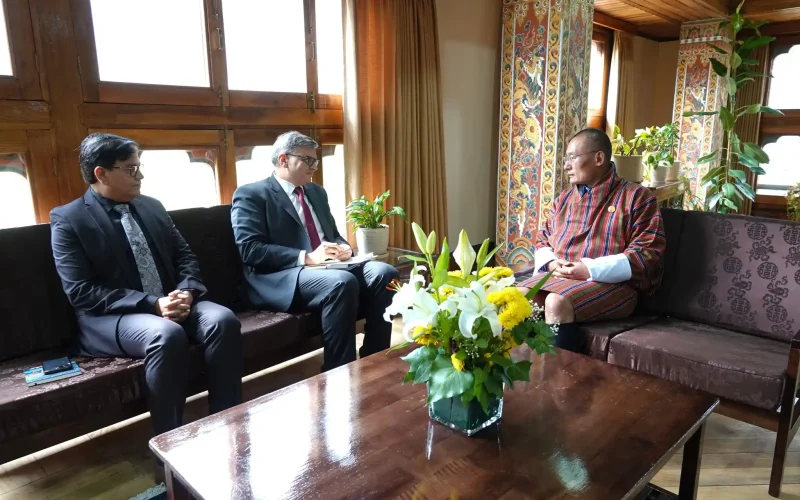
The International Solar Alliance (ISA), led by Director General Mr. Ashish Khanna, continues to drive global solar energy adoption through strategic partnerships. In a recent high-level mission to Bhutan (March 23–27, 2026), the ISA delegation provided critical updates on the implementation of the ISA–Bhutan Country Partnership Strategy (CPS) 2025–2029. This five-year framework, endorsed in September 2025, aligns with Bhutan’s National Energy Policy 2025 and supports the country’s ambitious National Solar Energy Roadmap (2025–2040).
The CPS focuses on policy reforms, project development, capacity building, and sustainable financing to diversify Bhutan’s energy mix, which is currently dominated by hydropower. A key target is achieving 5,000 MW of solar capacity by 2040, with intermediate milestones of 1,000 MW by 2029 and 2,500 MW by 2034. This expansion aims to enhance energy security, support rural electrification, create jobs, and contribute to Bhutan’s climate goals.
The ISA is a collaborative initiative between India and France aimed at uniting efforts to combat climate change by implementing solar energy solutions.
During the mission, ISA experts shared specific recommendations on solar power tariffs and storage integration, essential for making projects bankable and reliable. Discussions also covered the development of electric mobility powered by solar energy, including potential applications for infrastructure like the Gelephu Mindfulness City. Emphasis was placed on sustainable financing mechanisms to attract private investment and scale distributed solar solutions. Additionally, the team highlighted progress on the Solar Technology Application Centre (STAR-C) at the College of Science and Technology in Rinchending. Inaugurated in October 2025, this facility serves as a regional hub for training, research, and local capacity building in solar technologies.
In response, strong support was extended for these expert recommendations. Further research and detailed assessments were encouraged, involving Bhutanese local experts to ensure context-specific solutions and effective on-ground implementation.
This collaboration marks a significant step from ambition to action, positioning Bhutan as a model for sustainable solar integration in mountainous and renewable-rich nations. By leveraging ISA’s global expertise alongside national priorities, the partnership promises long-term economic, environmental, and social benefits.


