



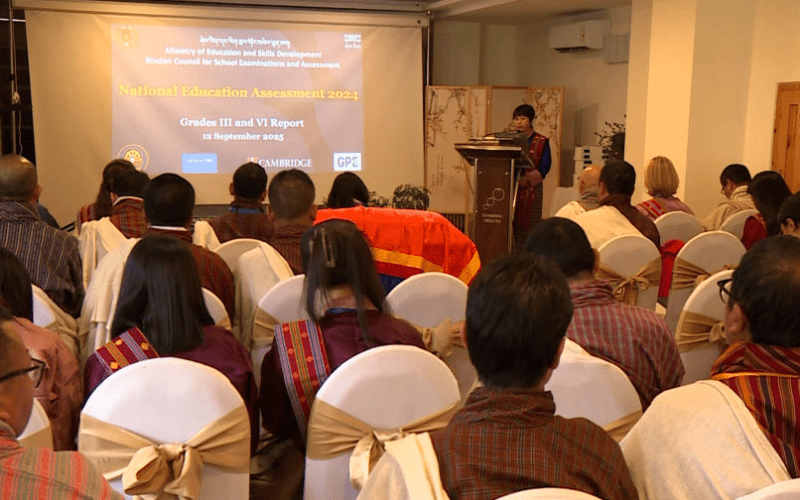
The latest National Education Assessment 2024 has highlighted stark differences in academic performance between students in urban and rural schools, reaffirming a persistent gap despite years of policy efforts.
The nationwide study, conducted last November by the Bhutan Council for School Examinations and Assessment (BCSEA), evaluated over 9,400 students from grades three and six. Results show that children in urban schools continue to outperform their rural counterparts in English, mathematics, and science.
Urban Advantage
According to the report, students in urban areas consistently scored higher in English Reading and Mathematical Literacy at grade three, and in English Writing at grade six. BCSEA officials attribute these outcomes to better facilities, reliable internet access, and greater exposure to learning opportunities available in towns and cities.
“Students from urban schools have more exposure to good facilities, while in rural schools, facilities, including internet connection, are not quite good,” explained Kinley Dorji, Executive Specialist with BCSEA.
Rural Struggles Continue
In contrast, students in remote communities continue to face significant challenges. Limited infrastructure, patchy connectivity, and resource shortages were identified as barriers that impede learning. The report emphasizes that these constraints make it difficult for rural children to keep pace academically.
Income levels also play a role. Findings suggest that students from higher-income families perform better across subjects, largely due to greater parental support and access to additional learning resources.
Call for Interventions
The BCSEA recommends urgent measures to bridge these disparities. Suggested interventions include providing targeted training for teachers in modern pedagogy and 21st-century skills, ensuring internet and Wi-Fi access in schools, and strengthening the teaching of English, mathematics, and science in rural areas.
“There is a need to give training to teachers in teaching, pedagogy training and 21st century skills,” Kinley Dorji said, underscoring the importance of equipping educators alongside improving facilities.
No Significant Progress Since 2021
This year’s findings mirror those from the 2021 assessment, signaling little change in the performance gap over the past three years. The report urges policymakers to revisit existing strategies and to craft updated policies that specifically address the needs of rural schools.
While urban students appear “lucky” with their greater access to resources, the assessment warns that without sustained interventions, the urban–rural education divide will persist, leaving many children in remote communities at a disadvantage.


