


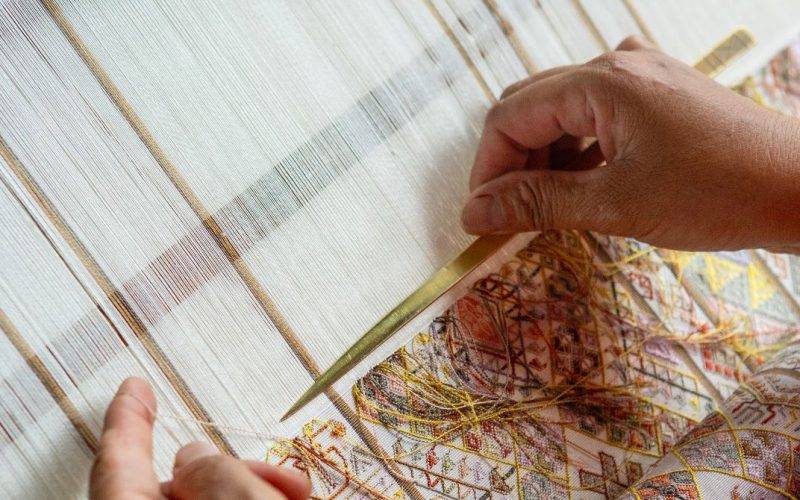
In a wooden farmhouse in Lhuentse, in Bhutan’s remote northeast, a woman sits before a backstrap loom lashed to a post, her body itself part of the machine—leaning back to create tension in the warp, easing forward to release it. She is weaving a kishuthara, one of Bhutan’s most prized textiles, and the pattern taking shape beneath her hands, a dense field of supplementary-weft brocade in crimson, saffron, and indigo, will take her the better part of a year to complete. A single such textile can cost more than a small car. Nobody here finds that surprising.
Weaving in Bhutan is not decorative craft; it is, arguably, the country’s primary visual language, more expressive and more codified than architecture or painting. Every region has its signature techniques and motifs—Lhuentse for its intricate kishuthara, Bumthang for yathra wool weavings in geometric patterns, Kurtoe for raw silk. Patterns carry meaning: certain motifs are reserved for religious textiles, others for royalty, others for everyday wear, and a trained eye can read a Bhutanese woman’s kira the way one might read a coat of arms—origin, occasion, even, sometimes, the weaver’s individual signature style.
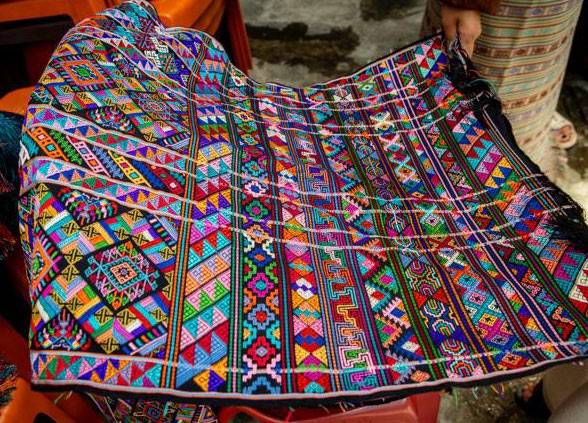
At the National Textile Museum in Thimphu, a modest but meticulously curated institution, the scale of the tradition becomes clear. Textiles here are displayed as diplomatic gifts, monastic donations, royal regalia—evidence that in Bhutan, cloth has long functioned as currency, as tribute, as prayer. One gallery is devoted entirely to the thagzo, the specific loom techniques unique to Bhutan, demonstrated by resident weavers who will, unprompted, explain the difference between thra, the supplementary-weft technique, and the plainer tsheshog ground weave, with the patience of people genuinely pleased that you asked.
What distinguishes Bhutanese weaving from textile traditions elsewhere is that it has remained almost entirely a living, working practice rather than a preserved relic. Girls still learn from mothers and grandmothers in farmhouses across the eastern dzongkhags; government initiatives have worked to formalize this apprenticeship without industrializing it, resisting the pull toward power looms that has hollowed out textile traditions elsewhere in Asia. A kishuthara bought in Lhuentse today was very likely made within a day’s drive of where you’re standing, by someone whose name the shopkeeper knows.
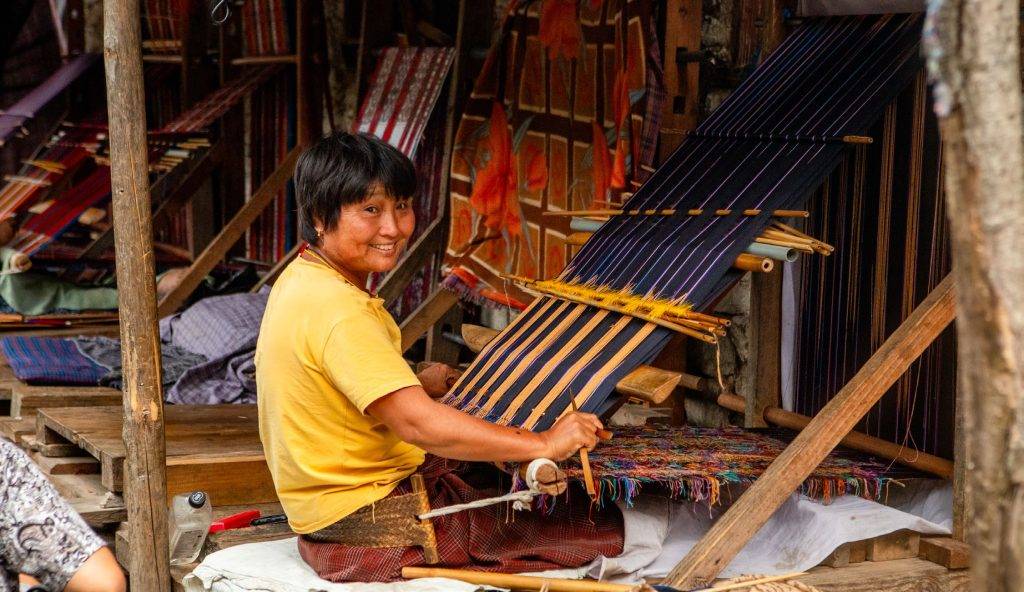
Visiting a weaving village, rather than simply a shop, changes the transaction entirely. In Khoma, a cluster of villages near Lhuentse considered the heartland of kishuthara weaving, looms sit on covered porches, in full view of the road, worked between other chores—a child fed, a fire tended, the shuttle picked back up. Conversations happen in the pauses. Weavers will show you unfinished pieces, count off the months remaining, name the motif and what it represents, usually a stylized flower or a Buddhist symbol whose meaning has outlasted whoever first wove it.
To carry a piece of Bhutanese textile home is to carry something genuinely singular—not souvenir but artifact, made by hand, at human pace, in a country that has decided, deliberately and at real economic cost, that some things are worth the time they take.


