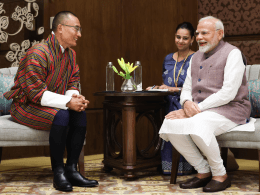
Prime Minister Tshering Tobgay’s recent meeting with U.S. President Donald Trump and U.S. Ambassador to India Sergio Gor in Florida marks a quietly significant moment in Bhutan–U.S. engagement, even if it is framed as an informal courtesy call rather than a formal state visit. The optics of the encounter at Trump’s Mar-a-Lago base signal Washington’s growing attentiveness to smaller Himalayan states at a time of sharpened regional competition in South Asia.
Reports and social media posts from Bhutanese and regional outlets indicate that Tshering Tobgay met Donald Trump in Florida during the prime minister’s first visit to the U.S. state, with Sergio Gor hosting the interaction. Gor, who has been nominated as U.S. Ambassador to India and acts as Special Envoy for South and Central Asia, publicly noted that he “enjoyed hosting” the Bhutanese leader in what was clearly curated as a high-visibility engagement.
The meeting appears to have taken place around the same time that India’s envoy to the U.S., Vinay Mohan Kwatra, met Gor at Mar-a-Lago for discussions on trade and broader bilateral priorities, underscoring that Florida is functioning as an active diplomatic hub for the Trump administration. For Bhutan, being slotted into this informal but symbolically important sequence of conversations gives Thimphu a rare, direct line into Washington’s evolving regional calculus.
For a small, landlocked kingdom historically careful about overexposure, a photo-op with the sitting U.S. president carries outsized strategic weight. It helps Bhutan diversify its diplomatic profile beyond its core relationships with India and, to a cautious extent, China, while still avoiding the trappings of hard alignment.
Tshering Tobgay has long framed Bhutan’s development path through the lens of Gross National Happiness, sustainability and gradual modernization, and this engagement gives him a platform to project those priorities to an American audience that typically encounters Bhutan only through tourism imagery. The Florida encounter also subtly reinforces Bhutan’s status as a stable, rules-abiding constitutional monarchy in a region marked by periodic political turbulence.