


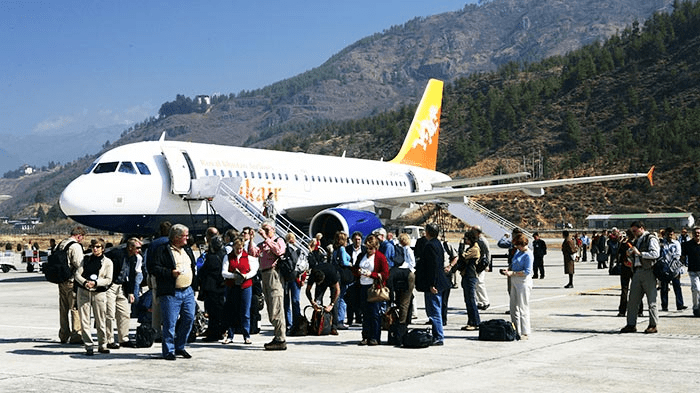
Bhutan has long promoted itself as a high-value destination rather than a mass-tourism market. That strategy has helped protect the country’s environment, culture and social fabric. Yet the growing preference among visitors for entering Bhutan by land reveals an uncomfortable truth: the cost of flying through Paro International Airport is no longer merely a matter of convenience. It is increasingly shaping who visits Bhutan, how they arrive and where tourism-related economic benefits are distributed.
More than 70 per cent of international tourists now reportedly enter Bhutan through land points at Phuentsholing, Gelephu, Samdrup Jongkhar and Samtse, with Phuentsholing receiving the largest share. Only around a quarter arrive through Paro International Airport.
The May figures illustrate the scale of this shift. Bhutan recorded 47,343 tourist arrivals during the month, but only 13,671 visitors entered through Paro Airport. By comparison, 31,163 arrived through Phuentsholing.
This is not necessarily evidence of declining interest in Bhutan. It may instead indicate that travellers are becoming more cost-conscious and strategic. Many visitors can fly to Bagdogra Airport in India and continue to Bhutan by road at a far lower overall cost than flying directly into Paro.
The difference is substantial. A one-way ticket from Paro to Bangkok has been priced at about Nu 49,785, while a return journey costs approximately Nu 93,476. A one-way Paro–Delhi ticket costs around Nu 38,555, with a return fare of about Nu 71,304.
By contrast, a Bagdogra–Bangkok ticket may cost around Nu 17,908 one way and Nu 35,414 return. Travel between Bagdogra and Delhi is cheaper still, at roughly Nu 6,847 one way and Nu 13,033 return.
For an individual traveller, and especially for a family or group, the savings can be significant. It is therefore unsurprising that tourists are choosing the longer road journey when it dramatically reduces the cost of reaching Bhutan.
The same price pressure affects Bhutanese citizens. Although citizens receive subsidised fares, air travel from Paro remains expensive. A one-way Paro–Delhi ticket costs about Nu 16,153, while the return fare is around Nu 31,737. Paro–Bangkok travel costs approximately Nu 20,742 one way and Nu 41,005 return.
Bhutan must therefore ask whether its aviation system is supporting its wider tourism and economic goals.
High-value tourism should not be confused with unnecessarily expensive access. Bhutan can maintain its commitment to responsible tourism while making air connectivity more competitive. Visitors may accept premium accommodation, sustainability charges and regulated tourism services when they understand the value behind them. Excessive airfare, however, often appears to travellers as a logistical penalty rather than a contribution to conservation or cultural preservation.
The growing reliance on Bagdogra also creates strategic vulnerabilities. Bhutan becomes increasingly dependent on infrastructure, flight schedules and transport networks outside its borders. It may also lose economic opportunities connected with airport services, domestic transport, hospitality and tourism spending along routes beginning in Paro.
The solution is not simply to force travellers back into the air. Land entry should remain a legitimate and important component of Bhutan’s tourism system. The government should instead examine why Paro fares remain so uncompetitive and whether greater airline capacity, improved scheduling, regional partnerships, seasonal pricing or carefully managed competition could reduce costs.
Better road facilities and services at land entry points are also necessary because this travel pattern is unlikely to disappear. But adapting to land tourism should not mean accepting the weakening of Bhutan’s aviation gateway.
Paro International Airport is more than an arrival point. It is part of Bhutan’s national image, connectivity and economic resilience. If flying into the country becomes unaffordable for most visitors, Bhutan risks allowing access costs—not tourism policy—to determine the future of its tourism sector.


