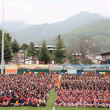

The sacred relics of Lord Buddha from India have arrived in Bhutan for a significant spiritual and cultural event. These relics, known as the Piprahwa-Kapilavastu relics, are bone fragments recovered from an ancient stupa in northern India, originally discovered in 1898 near the Nepal border in Uttar Pradesh. They are among the most venerated objects in global Buddhist tradition, representing a tangible connection to Lord Buddha’s physical presence and legacy.
The relics are in Bhutan from November 8 to November 18, 2025, coinciding with the Global Peace Prayer Festival (GPPF) in Thimphu. This festival is a 16-day celebration dedicated to world peace, held alongside the 70th birth anniversary of Bhutan’s fourth king, Jigme Singye Wangchuk. The relics are publicly displayed at Kuenrey Hall in the Tashichho Dzong, an important monastery and administrative center in Bhutan’s capital, Thimphu.
India’s gesture of sending the relics is seen as a symbol of deep spiritual and cultural cooperation between the two Himalayan nations. Bhutan’s Prime Minister Tshering Tobgay expressed gratitude to Indian Prime Minister Narendra Modi, describing the relics as a gift symbolizing shared spiritual collaboration beyond political and developmental ties.
The relics have previously been exhibited in countries like Mongolia and Thailand, and their arrival in Bhutan is part of India’s broader initiative to share its Buddhist heritage globally. This visit marks the second time the relics have been displayed in Bhutan, the first being in 2011 during the wedding celebrations of Bhutan’s current king, Jigme Khesar Namgyel Wangchuck.
The relics’ journey also highlights efforts to protect and repatriate these priceless artifacts. In 2025, India successfully prevented the smuggling and sale of these relics at a Sotheby’s auction in Hong Kong, ensuring their return through concerted diplomatic and cultural efforts supported by government and private sectors.
Alongside the relics’ display, three special exhibitions are being organized by the International Buddhist Confederation to enrich the spiritual experience. These exhibitions focus on the life and teachings of Lord Buddha, the sacred legacy of his relics, and the life of Guru Padmasambhava, an important figure in Bhutanese Buddhism. Additionally, selected sculptures from the National Museum of India’s Buddhist Art and Heritage Gallery are on display in Bhutan.
Buddhism has long been integral to Bhutan’s cultural identity, influencing religious institutions, heritage sites, and its unique development philosophy of Gross National Happiness, which emphasizes compassion and well-being. The relics’ arrival reinforces the shared Buddhist heritage and strengthens the spiritual and cultural ties between India and Bhutan, symbolizing a call for global peace and mutual reverence.
This historic event in Bhutan, supported graciously by the Government of India, serves as a powerful reminder of the enduring legacy of Lord Buddha and the special bonds between the two nations rooted in spiritual tradition and friendship.