


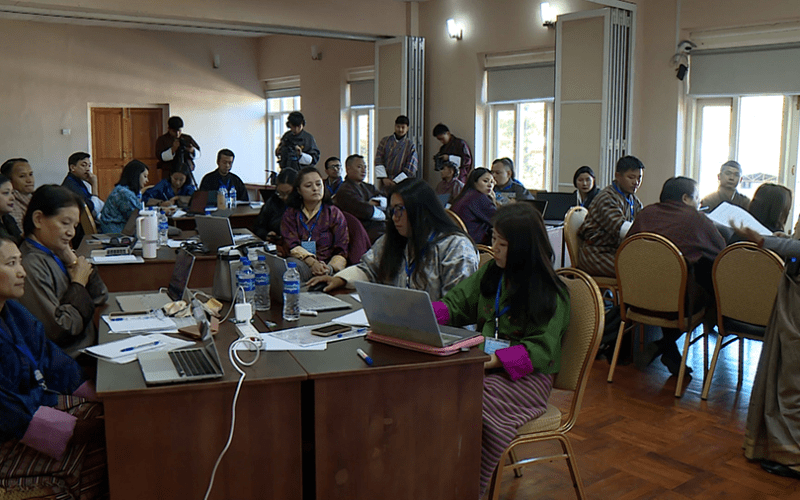
In a proactive move to prepare for the digital future, 25 lecturers from colleges across Bhutan recently gathered to explore the evolving role of artificial intelligence (AI) in education. Over a two-day workshop, participants dove into the practical and ethical dimensions of integrating AI tools into teaching, signaling a nationwide effort to enhance learning while preserving human-centered values.
The workshop, centered on strengthening AI literacy among educators, introduced attendees to a suite of cutting-edge tools including ChatGPT, Gemini, and NotebookLM. From mastering the art of crafting precise prompts to designing assessments and interactive lessons, lecturers experimented hands-on with technology poised to redefine educational workflows.
“We discussed various AI tools that educators can use. For teachers, preparing lesson plans and materials without AI can take days. But with AI, it now takes only a few hours,” noted Dipan Pradhan, Associate Professor at Royal Thimphu College.
Educators also reflected on the long-term potential of AI to streamline tasks and enhance creative teaching methods. Amrit Sharma, a lecturer from Gedu College of Business Studies, highlighted how the training offered a meaningful look at integrating AI throughout the teaching process—from curriculum design to assessment. “This workshop has given us insights into how we can use artificial intelligence as the new normal in our teaching and learning practices.”
However, amid the push for innovation, lecturers stressed the importance of guiding students on the ethical use of AI. Pratika Pradhan, a lecturer at Royal Thimphu College, emphasised that educators themselves must stay updated: “You make sure that you are educated enough in terms of AI, ethical principles, and guidelines. Instead of denying AI, teach your students how to use it so they don’t misuse it.”
The workshop facilitators reiterated the belief that AI should serve to elevate—not replace—teachers. “It’s not about teaching about AI. We are focusing on how to strategically use it to enable critical thinking and innovation, and to use AI as a collaborator,” said Dr. Pallavi Majumdar, Professor of Communication Arts at Royal Thimphu College.
Backed by the Canada Fund for Local Initiatives (CFLI), the workshop is part of a larger project titled “Strengthening AI Literacy among Higher Education Faculty in Bhutan through Online Modules, Hands-on Training, and Faculty-led Innovation Projects.”
As Bhutan’s educators continue to adapt to a rapidly changing digital landscape, initiatives like these reinforce a future where technology and ethics advance hand in hand. With AI becoming an integral tool in classrooms, the aim remains clear: to enhance human connection in education, not replace it.


