


As Bhutan celebrates the 70th Birth Anniversary of His Majesty the Fourth Druk Gyalpo, the nation pauses not merely to honour a leader, but to reflect on a vision — one that redefined the very meaning of progress.
In a world obsessed with growth measured in digits and decimals, His Majesty Jigme Singye Wangchuck chose to measure something infinitely deeper: the happiness of the people. More than half a century ago, when he declared that “Gross National Happiness is more important than Gross Domestic Product,” the statement seemed audacious — even idealistic. Yet, in those few words, Bhutan found its guiding philosophy, and the world found a new definition of success.
A Vision Rooted in Wisdom
His Majesty’s philosophy of Gross National Happiness (GNH) was not born in boardrooms or economic forums. It was born from compassion — from a deep understanding that a nation’s true wealth lies not in its material possessions, but in the well-being of its people, the vitality of its communities, the purity of its environment, and the strength of its values.
Former Education Minister Thakur S. Powdyel once observed, “As young as His Majesty was when he articulated this development vision, he knew that it was an articulation of the deepest yearning of all human beings across time and space.”
Today, that vision continues to guide Bhutan’s path — not as a slogan, but as a lived philosophy that shapes every decision, from national policy to daily life.
Happiness in Everyday Bhutan
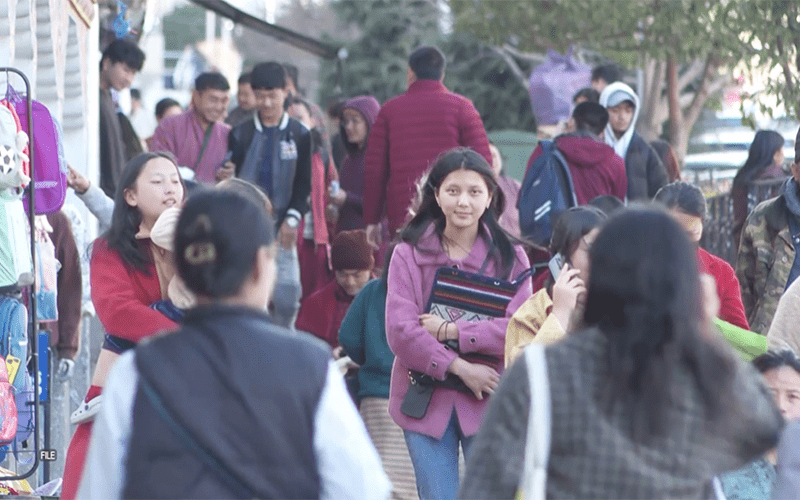
Walk through the streets of Thimphu and you will find that happiness in Bhutan is not abstract. It smiles from the faces of schoolchildren, thrives in close-knit communities, and echoes through the kindness of strangers.
“I really think it was a great decision by His Majesty to introduce Gross National Happiness,” said Namkha Karma Phuntshok, a student of Changzamtog MSS. “Because of GNH, our country is not only happy but also thriving. Our economic growth may not match other nations, but it is sustainable for future generations.”
Another student, Norgyel Rabgay, added, “In Bhutan, even our neighbours are like close friends. When I lived abroad, that sense of connection was missing.”
Visitors to the kingdom often notice the same spirit. “The idea of Gross National Happiness isn’t just a slogan — it’s something you can actually feel,” shared Tristan Cotton, a tourist. His wife, Tamara, added, “People in Bhutan seem genuinely happy. The warmth we’ve experienced here has made us happy too.”
For residents like Choneyla of Thimphu, the source of that joy is clear: “It is thanks to His Majesty the Fourth Druk Gyalpo for introducing Gross National Happiness and making this country a happy and peaceful place to live in.”
The Four Pillars of a Peaceful Nation
GNH rests on four timeless pillars — sustainable and equitable socio-economic development, environmental conservation, cultural preservation and promotion, and good governance.
Together, they form a moral compass for Bhutan’s growth, ensuring that every stride toward modernity remains in harmony with tradition, nature, and spirit. Enshrined in the Constitution of Bhutan, GNH is not only a policy but a shared national duty — binding government and citizen alike to protect what truly matters.
Powdyel explained, “All our projects are vetted against the principles of Gross National Happiness. Over time, there may have been varying emphasis, but at the heart of all our plans — whether in ministries or private enterprises — lies the spirit of GNH.”
A Global Legacy of Joy
What began as a distinctly Bhutanese ideal has now blossomed into a global movement. The Gross National Happiness Centre of Bhutan recently signed an MoU with Luciana Leão Raposo da Silva to establish the first GNH Centre in Latin America, located in Brazil — the fifth of its kind worldwide.
The new centre aims to adapt Bhutan’s happiness model to Brazil’s context, integrating well-being, cultural diversity, and environmental balance into sustainable development.
“As a matter of fact,” Powdyel noted, “there is a move to develop the capital city of Brazil into the happiness capital of the country. Different states are working to understand and infuse Gross National Happiness into their own development programs.”
Through such collaborations, Bhutan’s message continues to ripple outward — reminding a restless world that true progress is measured not by accumulation, but by harmony.
A Legacy That Lights the Future
As Bhutan stands at the crossroads of tradition and transformation, His Majesty the Fourth Druk Gyalpo’s timeless vision remains its guiding light. The philosophy he gifted his people ensures that modernization never comes at the cost of meaning, and that progress never outruns peace.
“Happiness,” “Peace,” “The Happiest Country in the World” — these are more than words. They are the living legacy of a monarch whose wisdom transcended his time, and whose compassion continues to shape generations.
On this 70th Birth Anniversary, Bhutan does not merely celebrate a leader — it celebrates a way of life, a philosophy, and a promise: that happiness, when nurtured with vision and values, can build not just a nation, but a better world.


