



On February 1, 2026, India’s Finance Minister Nirmala Sitharaman presented the Union Budget for 2026-27, and once again, Bhutan emerged as the largest recipient of India’s foreign aid allocations. With a generous outlay of ₹2,288.55 crore earmarked for our kingdom, this allocation underscores the depth of our bilateral ties and India’s unwavering commitment to Bhutan’s development. This figure, part of the Ministry of External Affairs’ (MEA) total budget of ₹22,118.97 crore, represents a strategic emphasis on India’s ‘Neighbourhood First’ policy, where Bhutan continues to hold a pivotal place.
In the grand scheme of India’s overseas development partnerships, which total around ₹6,997 crore for the fiscal year, Bhutan accounts for the lion’s share. This allocation is an increase from the revised estimates of ₹1,950 crore in 2025-26, signaling growing support for our infrastructure, hydropower, and socio-economic projects. Compared with other neighbors, Nepal received ₹800 crore; the Maldives and Mauritius each received ₹550 crore; Sri Lanka ₹400 crore; and Myanmar ₹300 crore. Even Afghanistan saw an uptick to ₹150 crore, reflecting India’s broader regional balancing acts.
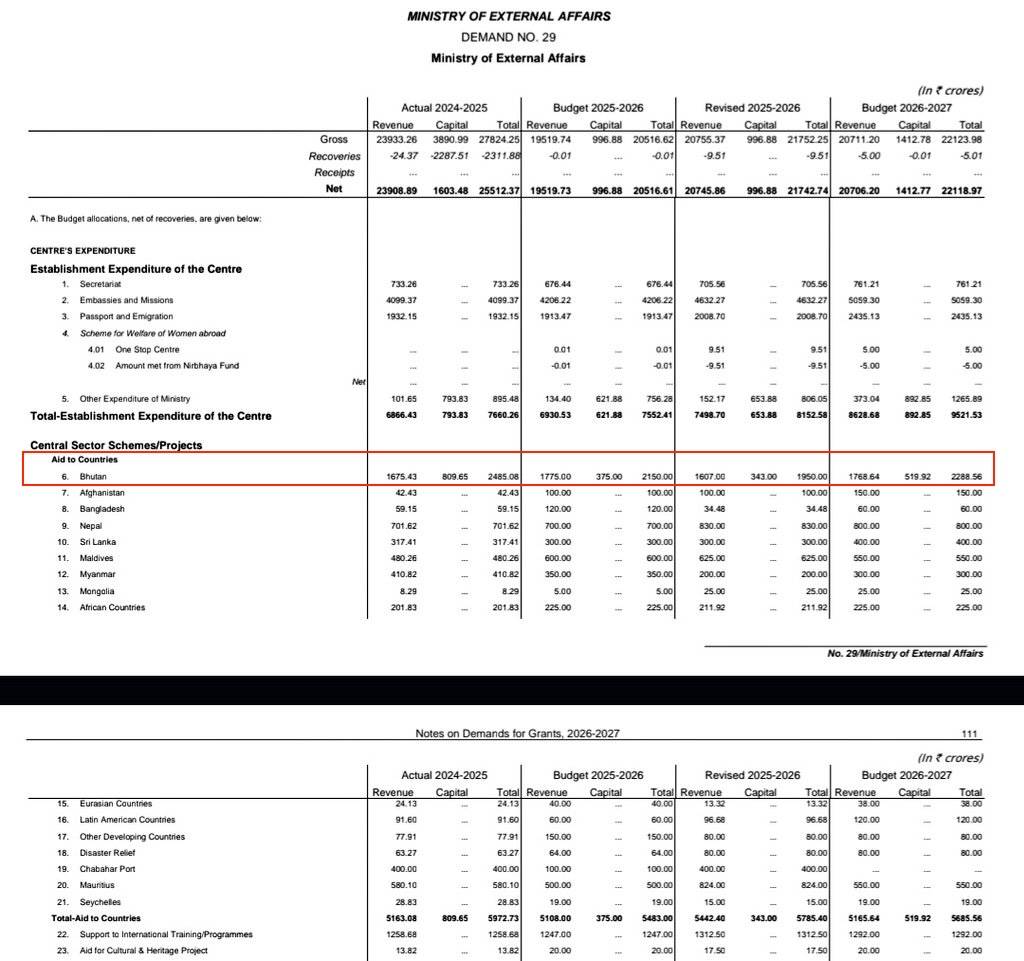
From Thimphu to Paro, this news resonates deeply because it directly impacts our daily lives. Much of this aid flows into critical sectors like hydropower, which forms the backbone of Bhutan’s economy. Projects such as the Punatsangchhu and Mangdechhu hydroelectric initiatives, jointly developed with India, have not only boosted our energy security but also generated revenue through exports back to India. In a year where global economic uncertainties loom, this financial infusion provides stability, enabling us to pursue our Gross National Happiness (GNH) philosophy without compromising on development goals.
The Deeper Significance
This budget allocation is more than just numbers on a ledger; it’s a testament to the unbreakable friendship between Bhutan and India, rooted in history and mutual respect. The 1949 Treaty of Friendship, updated in 2007, laid the foundation for this special relationship, emphasizing cooperation in foreign policy, defense, and economic matters. For Bhutan, a landlocked nation nestled in the Himalayas, India’s support has been instrumental in navigating geopolitical challenges, including border security along our shared frontier with China.
From our viewpoint, this aid signifies trust and partnership. India has consistently been our largest development partner, contributing over 70% of Bhutan’s external grants in recent years. It’s not paternalistic assistance but a collaborative effort that benefits both sides. For instance, Bhutan’s hydropower exports help meet India’s growing energy demands, fostering a symbiotic economic tie. Culturally and socially, the open borders, free trade, and people-to-people exchanges—evident in the thousands of Bhutanese students studying in India—strengthen our bonds.
In an era of shifting global alliances, this priority given to Bhutan in India’s budget reaffirms our strategic importance. It counters external influences in the region and ensures that Bhutan can maintain its sovereignty and environmental commitments, such as remaining carbon-negative. For us, it’s a reminder that in India, we have a neighbor who views our progress as integral to its own security and prosperity.
As we celebrate this milestone, it’s worth noting the evolving nature of our ties. Recent initiatives like the Bhutan-India Startup Initiative and enhanced connectivity projects, including rail links, promise to deepen integration. The budget’s focus on Bhutan also aligns with India’s Act East policy, positioning our kingdom as a gateway to Southeast Asia.
In conclusion, the Union Budget 2026’s allocation to Bhutan is a powerful symbol of enduring solidarity. It reassures us that amidst international turbulence, the Bhutan-India friendship remains a beacon of stability and shared vision.


