


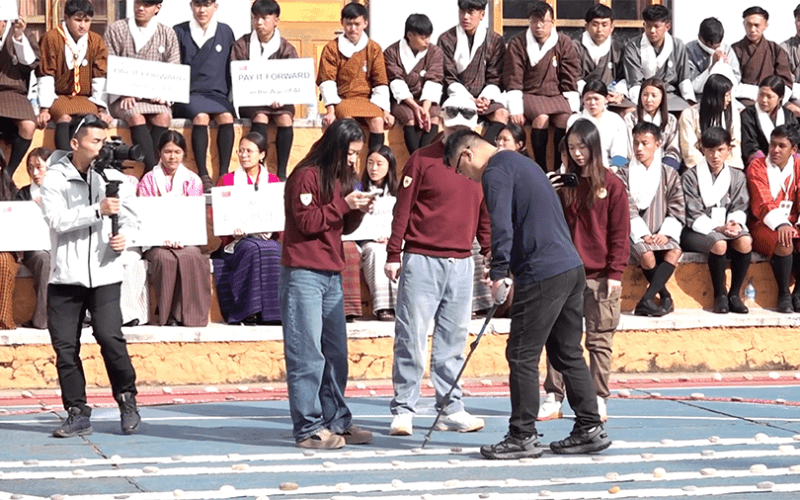
In a remarkable display of unity and compassion, nearly 200 volunteers from five countries came together in Bhutan to set a new Guinness World Record for the longest chain of envelopes, linking more than 11,000 handwritten messages into a single continuous line.
The record-breaking attempt, held at the basketball court of Paro College of Education, surpassed the previous record of 10,555 envelopes. Participants from Bhutan, Canada, Australia, the United States, and China carefully arranged and connected the envelopes, gradually transforming the court into a powerful visual symbol of global connection.
Organised by the Canada-based non-profit Heart Chorus Association International, the event unfolded methodically as volunteers laid thousands of envelopes across the floor. Each piece was linked one by one, eventually forming two large heart shapes—an intentional design reflecting the spirit of the initiative.
Every envelope carried a handwritten message of kindness or blessing, contributed by students, volunteers, and supporters from around the world. These messages, though simple in nature, were rooted in a shared goal: to spread encouragement and goodwill across borders.
Speaking at the event, founder Eva Wong emphasised the importance of preserving human touch in communication. She noted that while technology and artificial intelligence have transformed how people interact, handwritten expressions still hold unique emotional value.
“In today’s digital age, we can generate almost anything without effort,” she said. “But there are certain things we must continue doing by hand to remind ourselves of our shared humanity.”
Organisers highlighted that the act of writing letters is central to the initiative. At a time when most communication is instantaneous and online, they hope such activities encourage people to slow down, reflect, and engage in more meaningful exchanges.
For students at Paro College of Education, the event carried lessons far beyond the record itself. Faculty and organisers described it as an opportunity to instill empathy and social responsibility among future educators.
Student Service Officer Tempa Gyeltshen noted that such initiatives help broaden students’ understanding of compassion. “It shows that kindness is not confined within us—it can extend outward to touch others in meaningful ways,” he said, adding that teachers play a crucial role in guiding students beyond academic learning.
Participants also reflected on the rarity of genuine, face-to-face interaction in modern life. Several students expressed that the event served as a reminder of the importance of real human connection in an increasingly digital world.
One student remarked that despite China’s large population, the choice of Bhutan as the venue highlighted the country’s potential to host impactful global initiatives. Another shared that the experience reinforced how meaningful in-person interactions can be compared to digital communication.
What sets this initiative apart, however, is its continuation beyond the record itself. Rather than preserving the envelopes as a static display, organisers plan to return most of them to the schools and volunteers who created them. From there, the messages will be passed on to strangers, allowing the chain of kindness to extend far beyond the event.
“The world record ends here, but the journey of these messages does not,” Wong explained. “They will continue travelling, carrying kindness from one person to another.”
The initiative first began in Toronto in 2015 and has since been held every few years in cities such as Sydney and locations across China. With each iteration, the project aims to reinforce the same message: that small acts of kindness can ripple across communities and cultures.
While the record in Paro may stand as a notable achievement, organisers believe its true significance lies in the lasting impact of the messages themselves—quiet reminders that even in a fast-paced, digital world, human connection remains essential.


