


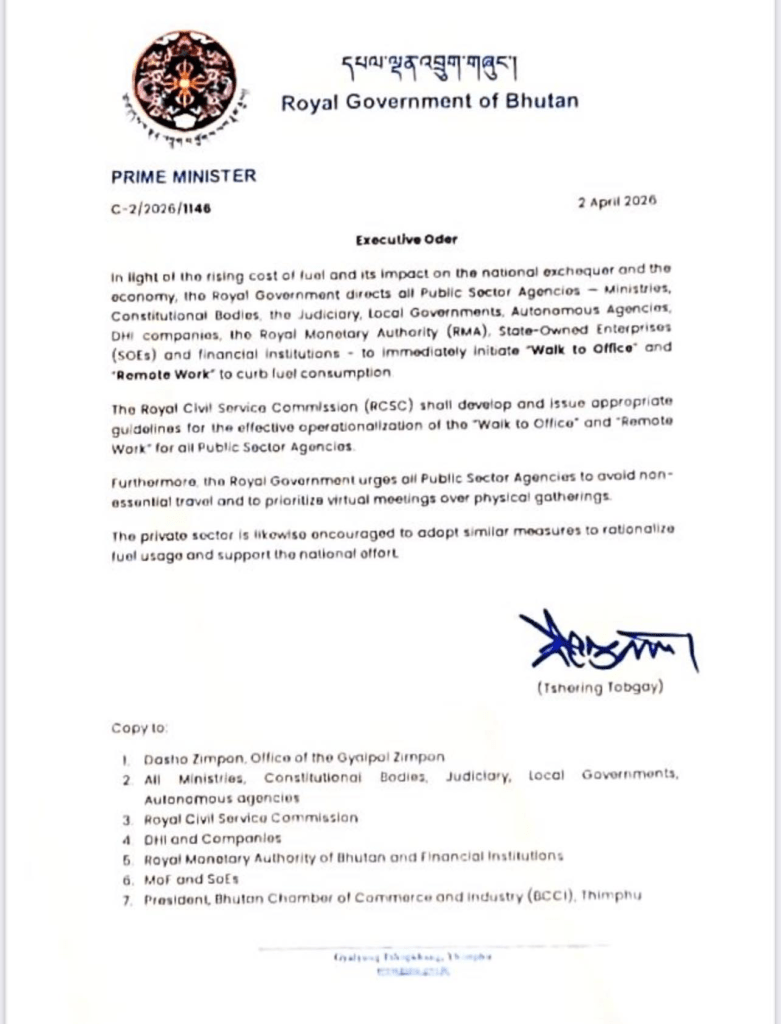
The Royal Government of Bhutan has announced a series of measures to address the recent surge in global fuel prices, combining immediate financial relief with long-term conservation efforts. The initiative, formalized through an Executive Order issued by the Prime Minister, reflects a balanced approach to protecting citizens while safeguarding public finances.
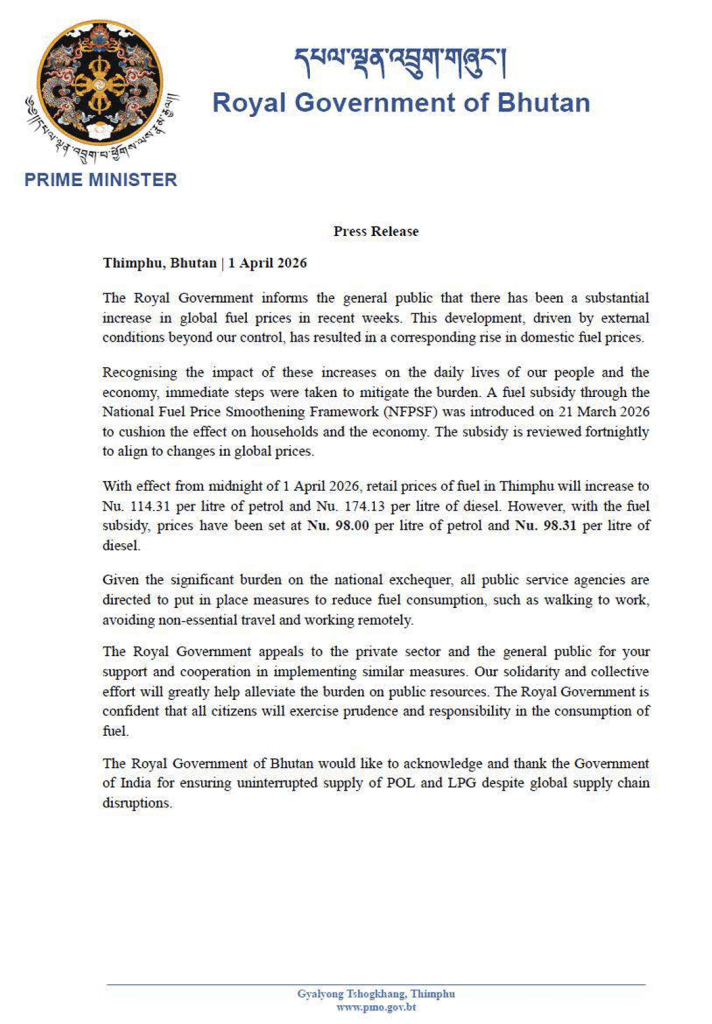
In recent weeks, global fuel prices have risen sharply due to external factors beyond Bhutan’s control. As a result, domestic fuel prices have also increased, placing pressure on households, transport systems, and the broader economy. To mitigate this impact, the government introduced a subsidy under the National Fuel Price Smoothening Framework (NFPSF) on 21 March 2026. This mechanism cushions consumers from sudden price shocks and is reviewed every two weeks to remain aligned with global market trends.
As of 1 April 2026, the retail price of petrol in Thimphu stands at Nu. 114.31 per litre and diesel at Nu. 174.13 per litre. However, with the subsidy in place, consumers are paying significantly reduced rates—Nu. 98.00 for petrol and Nu. 98.31 for diesel—providing much-needed relief.
At the same time, the government has acknowledged that sustaining such subsidies places a considerable burden on the national exchequer. In response, the Executive Order directs all public sector agencies to implement fuel-saving measures, including walking to work where feasible, minimizing non-essential travel, adopting remote work, and prioritizing virtual meetings. The private sector and the general public have also been urged to follow similar practices, highlighting the importance of collective responsibility.
A critical factor enabling Bhutan to manage this challenge is its strong and enduring partnership with India. Despite ongoing global supply chain disruptions, India has ensured the uninterrupted supply of petroleum products (POL) and LPG to Bhutan. This support has been vital in maintaining stability and preventing shortages during a period of international uncertainty.
The Bhutan-India partnership, built on mutual trust and close cooperation, continues to play a key role in Bhutan’s economic resilience. Reliable access to fuel imports allows the government to focus on domestic policy responses without the added risk of supply disruptions.
Bhutan’s approach reflects a careful balance between immediate relief and long-term sustainability. While subsidies help shield citizens from rising costs, conservation measures aim to reduce overall fuel consumption and ease fiscal pressure. The success of this strategy will depend largely on public participation and adherence to the guidelines.
As global uncertainties persist, Bhutan’s response demonstrates the value of proactive governance and strong regional partnerships. Through coordinated policy action and continued cooperation with India, the country is working to navigate the challenges of rising fuel prices while maintaining economic stability and public well-being.


