


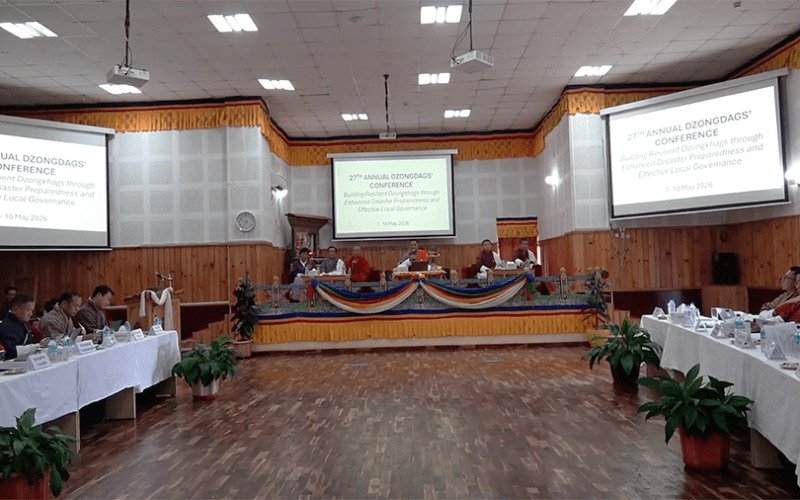
As Bhutan continues to face increasing risks from climate-related disasters, district leaders are intensifying efforts to improve preparedness and strengthen local governance. These issues took center stage at the 27th Annual Dzongdags’ Conference, which opened yesterday in Tsirang under the theme, “Building Resilient Dzongkhags through Enhanced Disaster Preparedness and Effective Local Governance.”
The four-day conference has brought together district administrators from across the country to deliberate on ways to reduce disaster risks, improve emergency response systems, and ensure stronger coordination at the local level.
Bhutan’s mountainous terrain and changing climate patterns continue to expose the country to hazards such as earthquakes, flash floods, landslides, and glacial lake outburst floods. Authorities say these threats highlight the urgent need for long-term preparedness and resilience-building measures.
Officials at the conference noted that disaster management has become a growing national priority in recent years. According to the Department of Local Government and Disaster Management, discussions on preparedness are now being integrated more actively into governance planning and policymaking.
Director General Karma Galay said that disaster preparedness had not received adequate attention in the past, leading to limited readiness during emergencies. However, he added that the issue has gained prominence over the last two years and is now firmly embedded in national discussions on development and governance.
Speaking during the opening session, Home Affairs Minister Tshering stressed the importance of coordinated planning and proactive governance in protecting communities from natural disasters. He said the government has already introduced several initiatives aimed at minimising risks, including the Earthquake Contingency Plan, the National Forest Fire Prevention Strategy, and the River Cleaning Plan.
Government records show that since 2013, Bhutan has spent an average of nearly Nu 300 million annually on disaster relief and emergency response efforts. To strengthen preparedness efforts further, Nu 2.56 billion has been earmarked for disaster management under the 13th Five-Year Plan.
The minister warned against complacency, noting that although Bhutan has been spared from large-scale catastrophic disasters compared to many countries, the risks remain unpredictable.
He also highlighted the broader responsibilities of district administrations, calling on Dzongdags to improve public service delivery, strengthen local infrastructure, support quality education, and preserve cultural heritage.
Emphasising efficient administration, the minister urged district officials to ensure uninterrupted public services and avoid delays caused by technical or administrative shortcomings.
The annual Dzongdags’ Conference serves as an important platform for district leaders to exchange experiences, assess development priorities, and review the implementation of national policies while addressing emerging local challenges.


