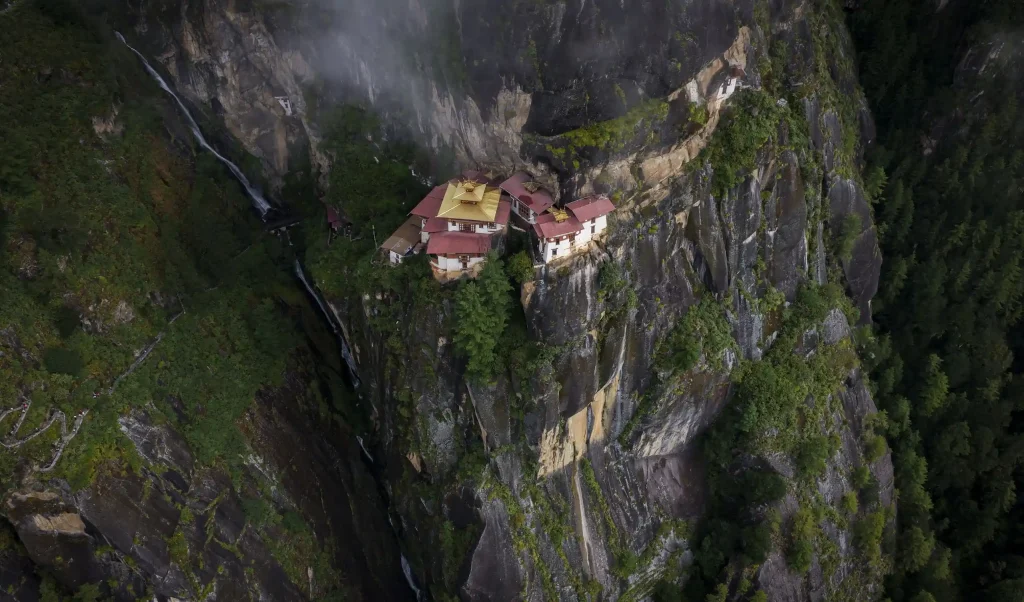
No photograph prepares you for the vertigo. Paro Taktsang—the Tiger’s Nest monastery—clings to a granite cliff nearly three thousand feet above the valley floor, so improbably placed that early visitors assumed it had been built by supernatural means. According to legend, Guru Rinpoche, the tantric master who brought Buddhism to Bhutan in the eighth century, flew here on the back of a tigress and meditated in a cave for three months. Whether or not you believe in flying tigresses, the climb itself will humble you into something like faith.
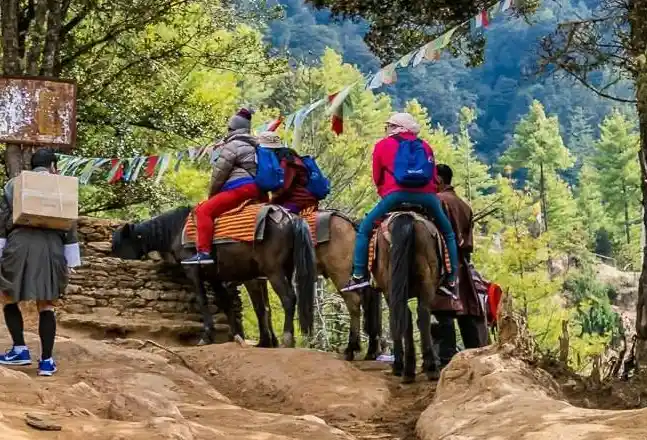
The trail begins gently, switchbacking through a forest of blue pine and rhododendron, prayer flags fluttering between trunks in tatters of red, blue, and white, bleached soft by seasons of sun. Mule trains pass with supplies, bells clinking, and for the first hour the ascent feels almost meditative—until the gradient steepens and the air, already thin at over ten thousand feet, starts to matter. Most visitors pause at the halfway teahouse, a wooden structure with a view so complete it functions as its own reward, sipping butter tea and watching the monastery’s white walls flash in and out of cloud like something imagined rather than built.
The final stretch is the test: a steep descent into a ravine, past a waterfall that plunges past a smaller shrine, then an equally steep climb back up stone steps worn smooth by centuries of pilgrims. It is, by design, not easy. Bhutanese Buddhism has never separated physical effort from spiritual arrival; the exhaustion is part of the offering.
Inside, the complex reveals itself as a cluster of temples rather than a single structure, connected by narrow stairways and balconies bolted to the rock face. Butter lamps gutter in dim rooms thick with juniper incense. Monks in maroon robes move between chambers with unhurried purpose. Photography is forbidden inside the shrines, which turns out to be a mercy—it forces you to actually look, rather than compose, at murals of wrathful deities and serene Buddhas rendered in colors that have not faded so much as deepened with age.
What strikes most visitors, beyond the vertiginous setting, is the ordinariness of devotion here. Bhutanese families climb Taktsang not as a bucket-list pilgrimage but as routine practice, prostrating at each shrine with a casualness that speaks to genuine, lived faith rather than performance. Children scamper ahead of grandparents; monks carry stacks of scripture as unremarkably as one might carry groceries.
The descent, oddly, is harder on the knees than the ascent is on the lungs, and by the time you reach the trailhead again—some five to six hours after starting, depending on your pace and how many times you stop simply to stare—there is a specific, hard-won satisfaction that no funicular or shortcut could replicate. Bhutan could have built a road to the monastery. It didn’t. The walk is the point: a physical translation of the idea that anything worth reaching should cost you something on the way.