Bhutan has many valleys that whisper legends, but none feel as timeless as Bumthang – the spiritual heartland of the kingdom. Its hills are etched with myths of saints, hidden treasures, and miracles that shaped Bhutanese Buddhism. In Bumthang, every hill holds a mantra and every river tells a story. To walk this valley is to follow the footsteps of saints, to step into legends that still breathe, and to discover that the holiest journeys are not only about reaching places, but about what changes within us along the way.
Here are five sacred places every traveler must explore to understand the depth of Bhutan’s spiritual landscape.
1. Jambay Lhakhang: The Temple of a Thousand Legends
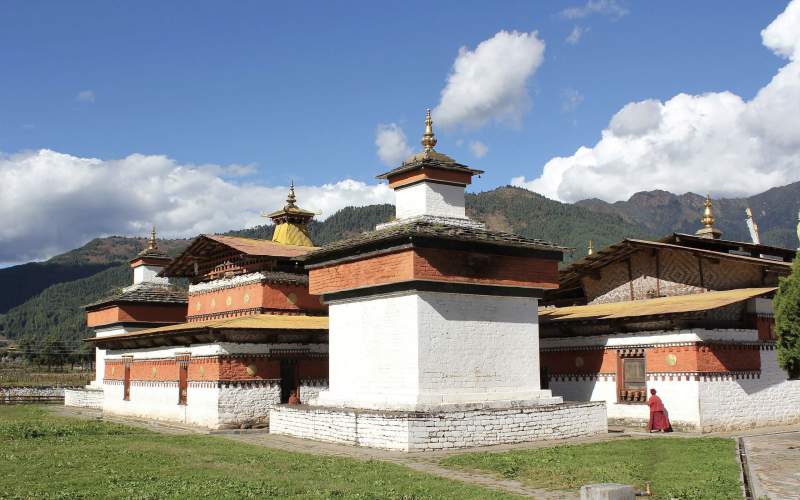
At first light, Jambay Lhakhang stands calm in the fog, its ancient walls glowing softly beneath prayer flags. One of the oldest temples in the Himalayas, it was built in the 7th century by Tibetan King Songtsen Gampo as part of a network of 108 temples pinning down a supine demoness said to obstruct the spread of Buddhism. Jambay Lhakhang is believed to rest on her left knee.
The temple bursts into life each autumn during the Jambay Lhakhang Drup, when masked dances, fire rituals, and sacred performances are enacted not for entertainment but for cleansing sins and awakening blessings. Standing here, one senses how deeply faith is woven into the rhythm of village life.
2. Kurjey Lhakhang: Where Guru Rinpoche Left His Body Imprint
Just a short drive from Jambay lies Kurjey, the most revered site in Bumthang. Here, Guru Padmasambhava (Guru Rinpoche), the legendary saint who subdued local deities and spread Buddhism in the 8th century, meditated inside a cave and left his body imprint on the rock. That sacred mark remains enshrined inside the oldest of three temples.
Visitors pass towering cypress trees and a long row of prayer wheels before entering the complex. Kurjey emanates an intense stillness, as if the valley itself pauses in reverence. Many Bhutanese believe that a pilgrimage to Kurjey ensures protection throughout one’s lifetime.
3. Tamzhing Lhakhang: The Living Legacy of Pema Lingpa
Across the river from Kurjey stands Tamzhing Lhakhang, the seat of Bhutan’s great treasure revealer, Terton Pema Lingpa. Built in 1501, it remains one of the few temples where his original paintings can still be seen, carefully preserved in their raw, faded beauty. Visitors may notice monks performing ancient dances wearing masks and costumes said to have been designed by Pema Lingpa himself. Tamzhing is a living museum, echoing the artistic and spiritual genius of the man whose teachings continue to shape Bhutanese religious culture.
4. Mebar Tsho: The Burning Lake
Hidden within the folds of Tang Valley is a place where faith once challenged the impossible. At first glance, Mebar Tsho is simply a dark, swirling river gorge, its surface broken by ripples of glacial water rushing between cliffs. Yet this spot carries one of the most extraordinary stories in Bhutanese spiritual history.

It was here in the 15th century that Bhutan’s revered treasure revealer, Terton Pema Lingpa, received visions foretelling the existence of sacred texts concealed under the water by Guru Rinpoche. When skeptics doubted him, he leapt into the depths holding a burning butter lamp. Hours passed. Then, emerging from the icy river clutching hidden treasures, and with the lamp still burning, Pema Lingpa silenced every doubt.
Today, visitors walk along the wooden pathway overlooking the gorge, gazing into water that looks impossibly deep, as though hiding secrets of its own. The wind whistles through the narrow valley, carrying the murmur of prayers offered by pilgrims who tie prayer flags and khadar to the railings. Locals leave small offerings of butter lamps and coins, believing that wishes whispered here are heard by the guardian spirits below the surface.
5. Tharpaling Monastery: Meditation Above the Clouds
Far above Chumey Valley, beyond pine forests rolled in mist and prayer flags snapping like wings in the wind, lies Tharpaling, a monastery named for liberation itself. Tharpaling was founded in the 14th century by Longchen Rabjam, known as Longchenpa, a philosophical and literary master whose works form the backbone of Nyingma Buddhist teachings. Here he composed some of his most important texts. The site became a sanctuary for deep meditation, a place where spiritual seekers retreated from worldly responsibilities in search of enlightenment.
Even today, the silence is profound, broken only by the rustling of prayer flags or the soft clack of giant prayer wheels turned slowly by monks and pilgrims. From the courtyard, the view spills into a panorama of layered valleys stretching far across Bumthang. It feels as though one is standing not above a landscape, but above time itself. Pilgrims come to circumambulate the powerful prayer wheels—massive cylindrical structures said to purify obstacles simply by walking around them. On auspicious days, the monastery fills with practitioners performing retreat practices, some living in small meditation huts clinging to the mountainside.