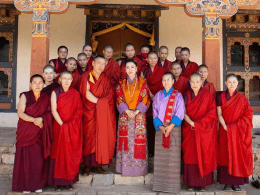
The newly established institute in Wangdue Phodrang will equip monks with English and Chinese language skills, strengthening international communication, translation and the global outreach of Bhutan’s Buddhist traditions.
Wangdue Phodrang, Bhutan: In an initiative aimed at connecting Bhutan’s centuries-old Buddhist traditions with an increasingly interconnected world, the Central Monastic Body has established the Monastic Institute for Language Studies in Gase Tshogom Gewog, Wangdue Phodrang. The institute seeks to equip monks with foreign language proficiency, enabling them to communicate Buddhist teachings to international audiences while supporting Bhutan’s expanding spiritual and cultural engagement with the world.
Formally inaugurated on Wednesday, the institute represents the first dedicated language-learning programme within Bhutan’s monastic establishment. Its curriculum initially focuses on English and Chinese, alongside the development of communication, interpretation and translation skills.
The initiative also aligns with the broader spiritual aspirations associated with His Majesty’s vision for Gelephu Mindfulness City (GMC), where the development of Dharma centres is expected to create opportunities for international exchanges and Buddhist learning.
The institute has commenced operations with seven monks enrolled in its inaugural two-year programme. Selected through an interview process, the students come from diverse monastic backgrounds, including individuals who previously held teaching and administrative responsibilities.
Among them is 37-year-old Dendup Dorji, whose decision to pursue language studies marks a significant transition in his monastic career. Having served for three years as Principal of Talo Sangngag Chholing Shedra in Punakha, Dorji stepped down from his position to return to the classroom.
His decision reflects a growing recognition within the monastic community that linguistic proficiency can complement traditional religious education and create new avenues for service.
Dorji hopes that acquiring proficiency in English and Chinese will enable him to contribute more effectively to the Central Monastic Body’s objectives, particularly in areas involving international engagement and the dissemination of Buddhist philosophy. He also sees language education as a means of supporting the spiritual dimensions of the Gelephu Mindfulness City initiative.
For fellow student Sherub Namgyal, the programme offers an opportunity to make Bhutan’s traditional Buddhist knowledge more accessible to people beyond its borders. He believes that familiarity with widely spoken international languages can help monks communicate their religious understanding while preserving the foundations of their monastic education.
The institute’s academic programme is being guided by Sean Weatherall, an American educator with several years of teaching experience, including time spent living and working in Bhutan. Serving as Director of Studies, Weatherall has expressed appreciation for the students’ progress, particularly their ability to integrate newly acquired language skills with the philosophical understanding developed through years of religious study.
This integration of linguistic training and Buddhist scholarship forms a central aspect of the institute’s approach. Rather than treating language acquisition solely as an academic pursuit, the programme seeks to prepare monks to explain religious concepts, participate in cross-cultural dialogue and engage with audiences unfamiliar with Bhutanese monastic traditions.
Kuenley Tenzin, President of the Monastic Institute for Language Studies, has identified the preparation of multilingual monks as an important institutional priority. He emphasised the institute’s intended contribution to the spiritual vision for Gelephu Mindfulness City, particularly as plans for Dharma centres create a need for religious practitioners capable of communicating across linguistic boundaries.
The initiative has also received encouragement from local community representatives. Chhador, Gase Tshogom Gup in Wangdue Phodrang, highlighted the importance of enabling Buddhist practitioners themselves to communicate their traditions internationally, rather than depending entirely on outside interpreters or intermediaries.
His observations underline a broader objective of the programme: ensuring that Bhutanese monks can participate directly in the international exchange of Buddhist knowledge while retaining the cultural and philosophical context of their teachings.
Beyond religious outreach, foreign language proficiency could also facilitate greater access to Buddhist literature, scholarly collaboration and translation activities. Such capabilities may help strengthen connections between Bhutan’s monastic institutions and Buddhist communities, researchers and educational organisations in other countries.
Although the institute has begun with a relatively small cohort, its administrators envisage expanding both enrolment and the range of languages offered. Future growth, however, will depend on the availability of financial resources and institutional support.
With its first seven students now undertaking formal language training, the Monastic Institute for Language Studies marks a new development in Bhutan’s approach to monastic education. By bringing foreign language instruction into an established tradition of Buddhist scholarship, the initiative seeks to create opportunities for monks to share their knowledge internationally while maintaining their grounding in Bhutan’s spiritual heritage.