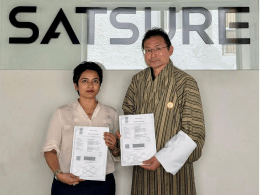
Druk Holding and Investments joins hands with US-based Tower Council Foundation to explore medical innovation, preventive healthcare and generational health research.
Bhutan is looking to diversify its economic landscape by exploring opportunities in healthcare research and medical innovation, marking a potential shift beyond its traditional dependence on hydropower and natural resources.
In a move aimed at developing new knowledge-driven industries, Druk Holding and Investments (DHI) has entered into a partnership with the United States-based Tower Council Foundation to explore the establishment of an international ecosystem for health research, clinical practice, data-driven solutions and medical innovation.
The collaboration seeks to introduce a broader approach to healthcare, placing greater emphasis on understanding the factors that influence long-term well-being rather than concentrating solely on treating diseases after they develop.
Central to the initiative is the concept of generational health, which examines how genetic characteristics, environmental conditions and lifestyle choices influence an individual’s health over a lifetime and potentially affect subsequent generations.
By bringing together scientific research, clinical expertise and emerging technologies, the partnership aims to explore ways of identifying health risks earlier, improving preventive care and supporting healthier lives across generations.
The Tower Council Foundation, an independent charitable organisation based in the United States, works towards advancing health outcomes across generations. Its collaboration with DHI is expected to provide a framework for exploring new approaches to medical research and healthcare delivery.
Several specialised fields have been identified as potential areas of cooperation, including regenerative medicine, healthy ageing, advanced medical diagnostics, women’s health and mental health.
These areas represent emerging opportunities in healthcare, particularly as medical research increasingly focuses on early detection, personalised treatment and improving quality of life over longer lifespans.
Beyond its potential implications for public health, the initiative also carries economic significance for Bhutan.
According to information released by DHI, the partnership is aligned with its 10X strategy, which seeks to accelerate economic diversification through the development of innovative industries and new sources of economic activity.
The proposed health ecosystem could create opportunities for scientific collaboration, entrepreneurship, private investment and the commercialisation of research-based innovations. It could also contribute to building Bhutan’s domestic capabilities in medical science, research and related professional fields.
For a country whose economic development has historically been closely associated with its natural resources, the exploration of advanced healthcare research represents an effort to identify new avenues for knowledge-based growth.
However, the partnership remains at a preliminary stage. Neither organisation has announced specific research projects, financial commitments or a timeline for implementing the proposed initiatives.
The eventual scale and impact of the collaboration will therefore depend on how the broad areas of cooperation are translated into concrete programmes, institutional partnerships and investments.
Nevertheless, the agreement signals Bhutan’s interest in positioning health research and innovation as part of its longer-term economic diversification efforts, while exploring healthcare approaches that extend beyond individual treatment to the well-being of future generations.