


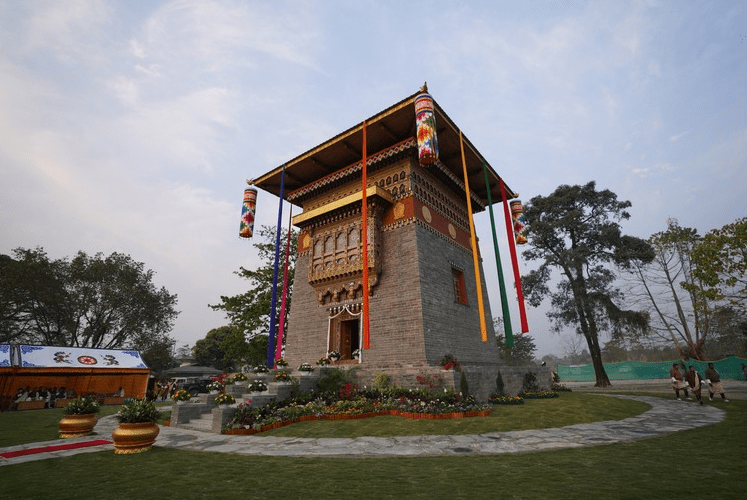
Visitors entering Bhutan’s ambitious Gelephu Mindfulness City from India are now welcomed by more than just a border crossing. Standing gracefully near the main entry gate, the newly constructed Ugyen Norlha Chorten has quickly become a defining landmark—one that signals not only arrival, but transformation.
Consecrated on February 21, 2026, in a sacred Rabney ceremony led by His Holiness the Je Khenpo and the central monk body, the chorten represents Bhutan’s enduring commitment to spiritual depth amid modern development. Its presence at the frontier offers a uniquely Bhutanese greeting: one rooted in reverence, reflection, and aspiration.
The monument, built by the dratshang and inaugurated by His Majesty The King, His Majesty the Fourth Druk Gyalpo, Her Majesty The Gyaltsuen, and members of the Royal Family, stands as both a religious sanctuary and a national symbol. It also commemorates the birth of Her Royal Highness the Gyalsem, with special prayers for her long life and wellbeing conducted as part of the consecration rites.
At its heart lies a shrine dedicated to Ugyen Norlha, a manifestation of Guru Rinpoche associated with prosperity. Yet the prosperity represented here goes beyond material wealth. In Bhutan’s Vajrayana tradition, it reflects a deeper vision—one where wisdom, compassion, and inner balance are the true sources of abundance.
This philosophy aligns closely with the broader vision of Gelephu Mindfulness City (GMC), Bhutan’s emerging model for development grounded in the principles of Gross National Happiness. The chorten, as the first completed spiritual structure in GMC, sets the tone for a city where economic growth and spiritual wellbeing are not competing goals, but complementary forces.
Religious scholar Lopon Pema Gyeltshen of Zhung Dratshang explains that the path forward is not about renouncing material life, but transforming one’s relationship with it. “When wealth is created and used with awareness, generosity, and compassion, it becomes a force for genuine good,” he notes. The chorten itself embodies this idea—a structure built not merely for worship, but as a foundation for mindful prosperity.
Architecturally, the chorten is rich in symbolism. Its walls are adorned with depictions of Buddhist deities and historical figures, each representing protection, longevity, and spiritual strength. From the southern side featuring forms of Dzambala—the guardian of wealth—to the northern depictions of the Five Sister Deities of prosperity, every detail reflects a carefully curated spiritual narrative.
Inside, sacred texts such as the Kangyur and Tengyur are enshrined as relics, while a smaller Sid-Dhok Chorten within the structure is dedicated to removing obstacles and ensuring harmony. The upper level houses thousands of statues representing key figures in Buddhist practice, creating an atmosphere of profound devotion.
Beyond its religious significance, the chorten is already influencing the region socially and economically. Communities across the nearby Indian border, particularly in Assam, have begun to feel the ripple effects of Bhutan’s development efforts. Local residents speak of increased access to healthcare, employment opportunities, and even cross-border cooperation in addressing public health concerns.
A Bodo elder from a neighboring village remarked that the new spiritual landmark brings “comfort and hope” to people on both sides of the border. Meanwhile, regional leaders anticipate that the Gelephu corridor could soon emerge as a major hub of growth, potentially surpassing other border towns in importance.
As Bhutan continues to chart a unique path of development, the Ugyen Norlha Chorten stands as a powerful reminder: prosperity, when guided by mindfulness and cultural wisdom, can uplift not just a city—but an entire region.


