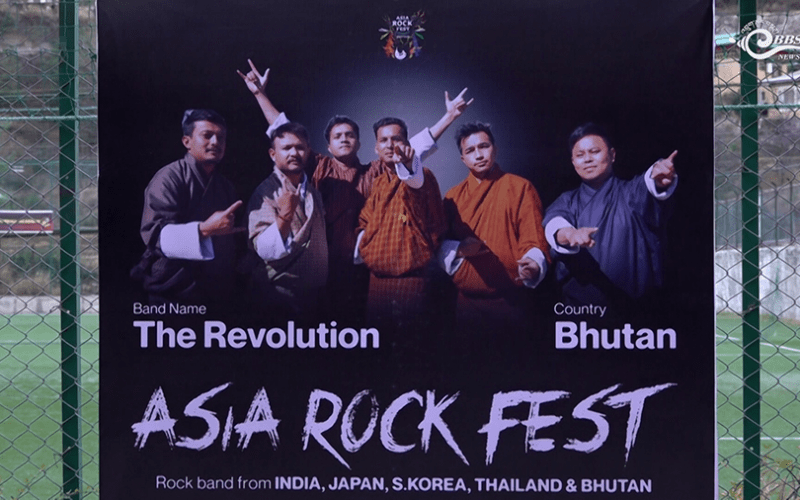
Bhutan is on the brink of a musical milestone. For the first time, the country will host a full-scale rock music festival, marking a turning point for a genre that has long existed on the fringes of Bhutan’s cultural landscape. This moment, however, is not the result of sudden excitement or imported trends. It is the outcome of years of perseverance by local musicians who continued to play rock music even when audiences were small and opportunities scarce.
The upcoming Asia Rock Fest–Bhutan is more than a loud celebration of guitars and drums. It represents a deeper movement to shape rock music with a Bhutanese voice—one that blends local language, folk traditions, and contemporary expression. The festival tells the story of how rock music in Bhutan has evolved from amateur jam sessions to a confident, professional scene ready to step into the spotlight.
Inside a modest rehearsal room in Thimphu, the band North H exemplifies this transformation. Formed in 2014, the group has spent years experimenting with the fusion of traditional Bhutanese melodies and lyrics with the raw energy of rock. The process has not been easy. Reworking familiar folk rhythms into something bold and modern requires patience, creativity, and a willingness to challenge expectations. For North H, performing at Asia Rock Fest–Bhutan is the culmination of nearly a decade of dedication.
Ugyen Tenzin, the band’s vocalist and bassist, knows these challenges well. Having performed for years, he observed that rock music in Bhutan struggled to find acceptance. Many bands, he says, felt pressure to soften their sound to appeal to wider audiences or secure performances, often at the cost of their artistic identity. For him, the idea of a dedicated rock festival always seemed like the missing piece—a space where musicians could perform original music without compromise.
Ugyen’s commitment to Bhutanese rock goes beyond the stage. After spending time in India, where he had opportunities to build a career, he chose instead to return home and help grow the local scene. Today, he serves as the Concert Director of Asia Rock Fest–Bhutan. What surprised him upon returning was discovering just how alive the scene already was. Despite limited exposure, there are now around 15 active rock bands performing across the country.
This progress stands in contrast to the struggles faced by earlier generations. Kunga Tenzin Dorji, a former member of the band Who’s Your Daddy, recalls how difficult it was to sustain a rock career in the past. Attempts to seek institutional support often led nowhere, and financial realities eventually forced the band apart. Yet even then, the passion for rock never disappeared—many of those musicians are still playing today.
For artists like Kunga, the upcoming festival feels like a revival. It offers a chance to reclaim a genre that survived through persistence rather than popularity. He believes that cultural exchange is natural and necessary, and that rock music in Bhutan can evolve without losing its roots. The support of government institutions, he says, signals a meaningful shift in how creative industries are valued.
The festival also highlights diversity within the scene. Sangay Lhaden, vocalist of The Sangay Lhaden Band, is excited to represent one of the few female-fronted rock acts in Bhutan. Her band will present a rock interpretation of a Bhutanese folk song, demonstrating that traditional music can adapt to new forms while retaining its essence.
For younger musicians like Rabi Kumar Ghalay, drummer of North H, the festival is an opportunity to introduce rock music to new listeners. He believes that exposure is key, and that once people experience the genre firsthand, they will better understand its depth and potential.
Adding to the significance of the event is the participation of international artists from India, Thailand, Japan, and South Korea. Among them is Parikrama, a legendary Indian rock band with a long history of connection to Bhutan. Their founder, Subir Malik, recalls first visiting the country in the mid-1990s and describes Bhutan’s current rock movement as vibrant and impressive. For him, sharing the stage with Bhutanese musicians is both exciting and meaningful.
As Asia Rock Fest–Bhutan prepares to take place in Paro next week, it marks the beginning of a new chapter for Bhutanese rock music. It is a celebration of creativity, resilience, and cultural expression—a sound shaped by global influences but grounded firmly in Bhutan’s own spirit.