


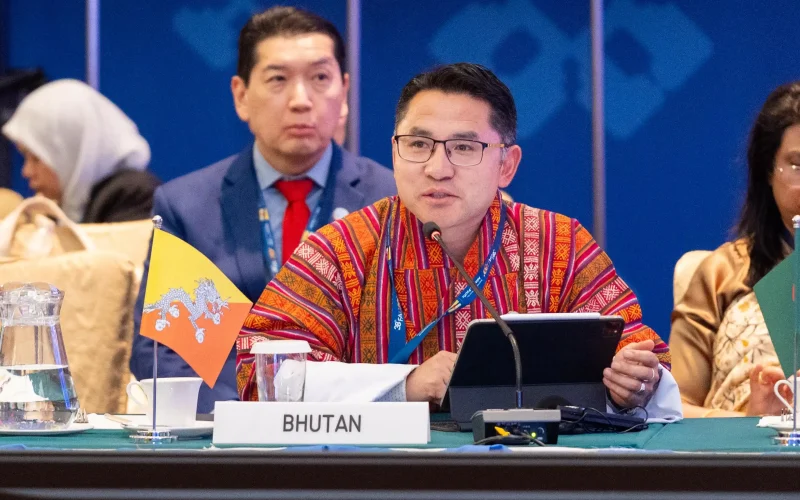
In a bold assertion of its development priorities, Bhutan has emerged as a vocal champion for placing farmers front and centre in the Asia-Pacific region’s push to transform agrifood systems, highlighting the kingdom’s commitment to sustainable, inclusive growth amid mounting climate and economic pressures.
Speaking at the 38th Session of the FAO Regional Conference for Asia and the Pacific, held from April 20 to 24 in Brunei Darussalam, Bhutan’s delegation underscored a farmer-first approach to agricultural modernisation. The conference, themed “Accelerating Agrifood Systems Transformation,” brought together ministers grappling with rising input costs, supply chain disruptions, and the impacts of global conflicts.
Agriculture and Livestock Minister Younten Phuntsho led Bhutan’s efforts, participating in high-level panels alongside counterparts from Laos, Papua New Guinea, and Tonga. In his keynote at the associated Asia-Pacific Food Forum, the minister spotlighted Bhutan’s success with the FAO’s One Country One Priority Product (OCOP) initiative, using quinoa — locally known as Ashi Heychum — as a flagship crop. He emphasised integrating science-based policies to drive evidence-backed development and sustainable value chains.
Commercialisation with Resilience
Bhutan aims to nearly double the agriculture sector’s contribution to GDP, from Nu 31 billion to Nu 50 billion, through scaled-up production, robust supply chains, and genuine income opportunities for rural communities. Central to this vision are protective measures such as the National Crop and Livestock Insurance Scheme and innovative wildlife fencing solutions, designed to shield farmers from climate shocks and human-wildlife conflict.
The country is also ramping up investments in climate-smart agriculture, including resilient crop varieties and expanded irrigation infrastructure. Despite its minimal contribution to global emissions, Bhutan experiences outsized climate impacts, making adaptation and regional collaboration essential.
Strategic Partnerships and Investment Forums
The strategy aligns with broader FAO initiatives, notably the Hand-in-Hand programme, which channels investments into high-potential districts to unlock agricultural value. Upcoming events like the Bhutan Agrifood Trade and Investment Forum (BATIF) 2.0, set for May 21-22, will further showcase opportunities for public-private partnerships, technology adoption, and market access.
Experts note that Bhutan’s smallholder-dominated farming landscape — characterised by fragmented plots and subsistence practices — requires professionalising farmer groups, fostering cooperatives, and building stronger links to markets and processors. Initiatives such as the USD 10 million project targeting six eastern districts focus on restoring degraded lands, introducing climate-smart practices, and supporting tens of thousands of farmers.
A Model for Vulnerable Nations
Bhutan’s approach resonates across the region’s Least Developed Countries, Landlocked Developing Countries, and Small Island States, which face shared challenges of geographic isolation, import dependence, and limited fiscal space. FAO Director-General QU Dongyu has praised such innovative national strategies for modernising agriculture while building inclusive rural economies.
Looking ahead, Bhutan is developing its Agrifood Sector Strategy 2034 through inclusive consultations involving farmers, women’s groups, the private sector, and youth. The goal extends beyond food security to multiplying farmer incomes, creating dignified rural jobs, and positioning the country as a regional exemplar of green, technology-driven agriculture.
By anchoring its transformation agenda in the lives and livelihoods of its farmers, Bhutan is not only addressing domestic food self-sufficiency and export ambitions but also contributing meaningfully to collective regional resilience. As discussions continue on new financing mechanisms like the AgriSustain Fund and informal ministerial networks for landlocked nations, the Himalayan kingdom’s farmer-centric model offers a compelling blueprint for turning vulnerability into sustainable opportunity.


