
In the remote highlands of Haa, a haunting melody reverberates across the valley, carried by the voices of its elder women. This is Chhundu Gongzhey, one of the region’s oldest traditional songs, performed in reverence to the valley’s guardian deity, Ap Chhundu. Despite its deep cultural roots, the future of this treasured tradition hangs precariously in the balance.
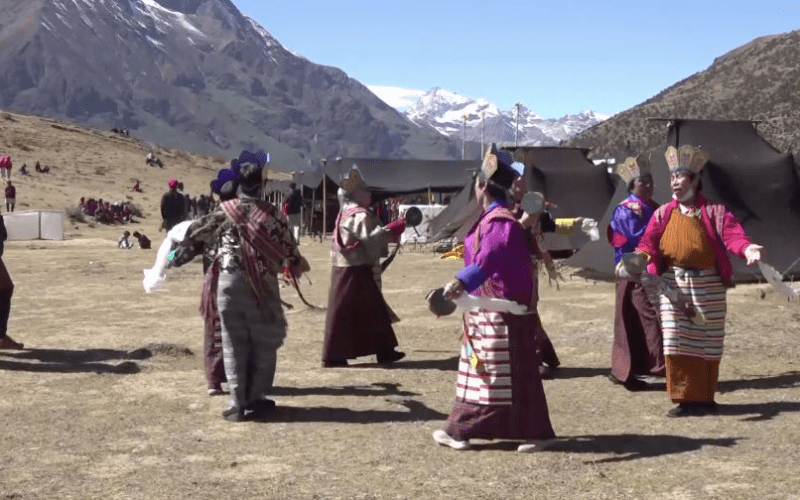
Led by 73-year-old Damchoe from Katsho Gewog, the Chhundu Gongzhey troupe recently showcased their elaborate song and dance at the Royal Highland Festival in Laya. Damchoe, along with nine other dancers from Katsho and Eusu Gewogs, brought the ancient melody to life once again. But beneath the rhythmic drumbeats of the Draru and the praises sung for Ap Chhundu lies an urgent fear: that this tradition may fade into silence.
“Only a handful of us are left who remember the steps and the words,” says Aum Damchoe, her voice lined with worry. “The young people say we look like shamans when we perform and show no interest in learning. I fear this song—which has blessed our valley for generations—will die with us.”
Chhundu Gongzhey is instantly recognizable by its distinctive costume and choreography. Performers drape a decorative cloth over the traditional kira, fold their rachu in a crisscross, don the headgear rig-nga, and dance solemnly with a drum in hand. While its exact origins are unwritten, local oral history dates the song back roughly 150 years.
The story of Chhundu Gongzhey’s journey is as rich as its melody. It was reportedly brought back to Bhutan by Dasho Sonam Tobgay, who encountered a similar performance called Jombai Paw during his time as ambassador in Tibet. Upon returning, he shared it with Aum Rinchen Dem of Haa Watsa, who passed it down through generations.
Today, just over ten elderly women—aged between 55 and 73—continue this ritual art form. Zangmo, a performer from Katsho Gewog, echoes the concern of her peers: “We are supposed to perform during the annual Haap Chhundu rituals, but recently, we were not called. If no one steps forward, who will sing for our protector deity when we are gone?”
But all is not lost. There is a renewed spark of hope. According to the District Culture Officer, Chhundu Gongzhey is poised to become a staple in major public celebrations. Starting next year, it will be formally taught to district dancers and performed during the annual Tshechu festival, ensuring that a new generation of Bhutanese carries forward the art.
For the people of Haa, Chhundu Gongzhey represents more than a melody—it is the living heartbeat of their cultural identity, linking the past to the present. With coordinated efforts and community participation, the sacred song may yet survive to echo through many more generations of the valley’s children.
“We have always believed that singing praises to Ap Chhundu keeps our valley blessed,” reflects Aum Damchoe, her eyes bright with renewed hope. “If the youth learn it, then the blessings—and our way of life—will live on.”