


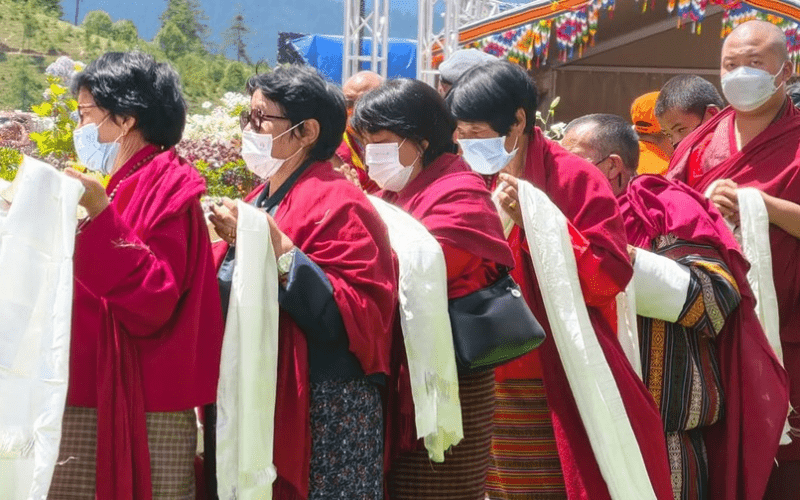
At Kuenselphodrang, where thousands of devotees have gathered for the month-long Kathrid Empowerment led by His Holiness the Je Khenpo, the event is creating more than an opportunity for spiritual learning. It is also giving rise to lifelong relationships rooted in Buddhist tradition, as participants formally become Dorji Puen—or Vajra Siblings.
The centuries-old practice establishes a sacred bond among devotees who receive the same Buddhist empowerment from a common guru. While unrelated by blood, Dorji Puen commit themselves to a lifelong relationship of mutual care, respect, and spiritual support, a connection many believe continues beyond this lifetime.
According to the Central Monastic Body, more than 1,800 groups have registered to take part in the tradition during this year’s empowerment. Each day, His Holiness confers khadar to over 600 groups, with each group consisting of seven devotees.
For participants, receiving the ceremonial scarf from His Holiness represents far more than a ritual. It signifies the formal beginning of a spiritual kinship that carries profound religious meaning.
Tenzin Namgay, a devotee from Paro, described the occasion as deeply moving.
“I feel fortunate to have formed this sacred relationship. We are now spiritual siblings, and I believe this bond extends beyond this life. Those older than me become my elder brothers and sisters, while those younger become my younger siblings. Receiving the blessing from His Holiness makes the relationship especially meaningful.”
Kuenzang Choden from Thimphu shared a similar sentiment, saying that the opportunity itself is considered the result of positive karma accumulated over previous lives.
“If we honour this relationship with sincerity, as advised by His Holiness, we may not only remain Dorji Puen in this lifetime but also be reborn as actual siblings in future lives. That belief makes this experience incredibly joyful.”
Religious scholars explain that the concept of Dorji Puen reflects an important aspect of Buddhist practice, where disciples receiving teachings or empowerments from the same guru become members of a shared spiritual lineage.
Tashi Tshering, Chhukha Lam Neten of the Central Monastic Body, said that while spiritual siblinghood accompanies many Buddhist empowerments, it holds particular significance during the Kathrid Empowerment.
“Participants are organised into groups of seven, a number regarded as especially auspicious in Buddhist teachings. The grouping symbolises harmony, interconnectedness, and the shared responsibility of progressing together on the spiritual path.”
The tradition also serves as a reminder that spiritual development is not solely an individual pursuit but one strengthened through community, compassion, and collective practice.
Over the years, some aspects of the accompanying celebrations have also evolved. Traditionally, newly formed Dorji Puen gathered for elaborate feasts following the ceremony. However, under the guidance of His Holiness the Je Khenpo, the observance has been simplified.
Tashi Tshering explained that the traditional tea-sharing ceremony has been retained while avoiding practices that could detract from the religious significance of the occasion.
“In the past, celebrations sometimes included meat and alcohol, introducing worldly elements into what is fundamentally a spiritual event. His Holiness advised that a simple tea gathering with light refreshments is sufficient to preserve the tradition while encouraging vegetarianism and maintaining the sanctity of the occasion.”
As the Kathrid Empowerment continues, thousands of devotees are leaving Kuenselphodrang with more than blessings and teachings. They depart having formed enduring spiritual families—relationships founded on shared faith, compassion, and responsibility.
In Bhutan, where Buddhist traditions continue to shape both personal and communal life, the institution of Dorji Puen remains a powerful reminder that family can be created not only through birth, but also through a shared spiritual journey.


