


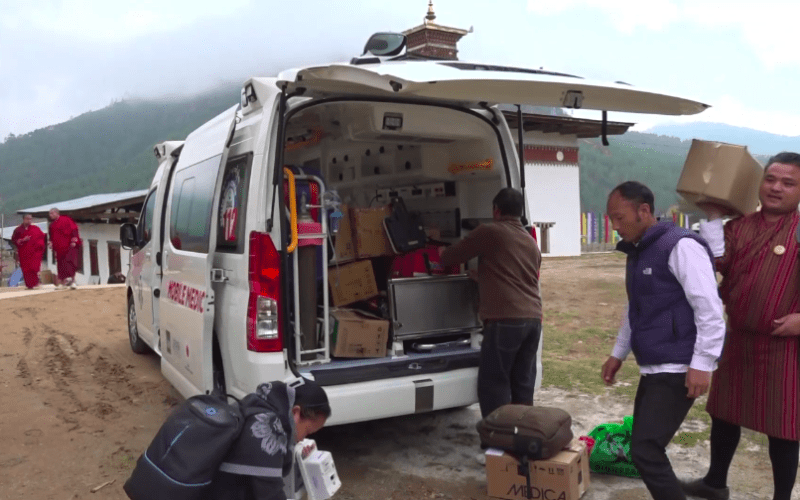
Access to healthcare is becoming easier for residents in some of Bhutan’s most remote communities, thanks to a new pilot programme launched by the Health Ministry of Bhutan. The initiative deploys Mobile Medical Units (MMUs) across the district, delivering essential medical services directly to villages that are often hours away from the nearest hospital.
In Khothangkha, a quiet settlement under Jangsa Dzong, villagers gathered as a mobile medical team set up a temporary clinic. For many, including elderly residents, the visit offered a rare opportunity to consult a doctor without the burden of travel.
Seventy-five-year-old Tshering, who has been managing high blood pressure for years, was among those seeking care. The journey to the district hospital—nearly 50 kilometres away—has long been a challenge.
“Even if we have a vehicle, we often do not know where to go. And even when we reach the hospital, we do not know which department to visit,” Tshering said. “Today, we can complete our check-up here without going anywhere else.”
The mobile unit team comprises a doctor, nurse, laboratory technician and pharmacist. Together, they provide a range of services, including blood pressure monitoring, diabetes screening, maternal and child healthcare, and on-the-spot distribution of medicines.
During a single visit to Khothangkha, around 150 patients were examined. Many had postponed medical attention due to work commitments, financial limitations or lack of support for travel. For elderly residents in particular, long-distance journeys to healthcare facilities remain a significant obstacle.
Local leaders say the programme is already making a noticeable difference. Khothangkha Tshogpa Karma Dorji noted that travelling to Rinchengang hospital for tests can be physically taxing, especially when patients must go on an empty stomach.
“Having these services come directly to the community makes a huge difference,” he said.
Residents also highlighted the importance of having female healthcare workers on the team. Yangka, a villager, explained that women often feel more comfortable discussing personal health concerns when a female nurse is present, especially given the difficulty of leaving household responsibilities behind to seek treatment.
Others pointed out that while local health workers provide valuable services, the mobile units bring additional expertise and equipment. “We can receive more advanced care here,” said Phuba, another resident.
The programme is supported by the Japan Fund for Prosperous and Resilient Asia and the Pacific and administered by the Asian Development Bank. Ten mobile units have been deployed so far.
Since its launch, the initiative has reached over 20 locations in Wangdue Phodrang, serving approximately 1,200 patients. Health officials say the outreach also helps identify individuals who may have missed follow-up appointments or ongoing treatment.
Kunzang Thukten, a planning officer with the Health Ministry, explained that while primary health centres traditionally focus on prevention, the mobile units expand services to include both preventive and curative care.
To ensure continuity, teams plan to revisit each location on a fixed monthly schedule, allowing residents to rely on consistent access to medical services. For areas with difficult terrain, officials are exploring alternative modes of transport to reach even the most isolated communities.
Looking ahead, the Health Ministry aims to expand the scope of services offered by the mobile units. Planned additions include dental care and eye screenings, such as cataract detection.
For now, in villages like Khothangkha, the impact is already clear. Patients leave the temporary clinics with medicines in hand and renewed confidence in their health—without ever having to leave their community.


