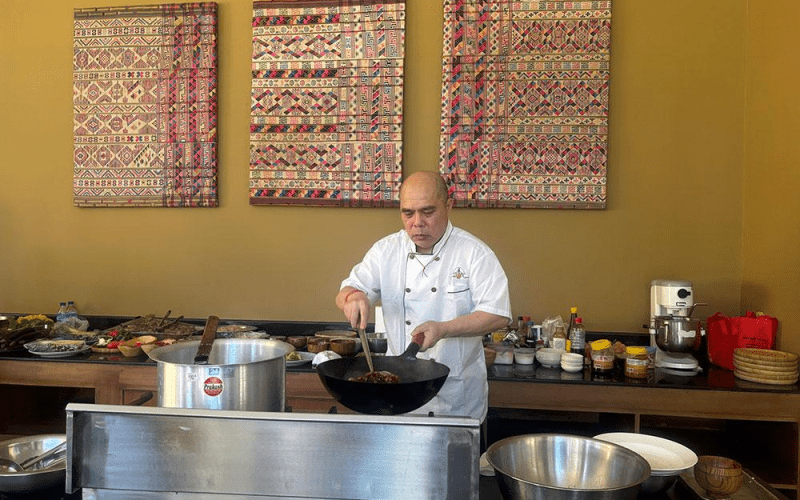
When master chef Wong Seng Wai—widely known in culinary circles as “the Noodle Man”—arrived in Bhutan recently, he was not chasing the latest food trends or scouting for commercial opportunities. Instead, his journey was driven by a quieter ambition: to understand a culture that still cooks with patience, purpose and a deep respect for what the land provides.
For the veteran chef, Bhutan represents something increasingly rare in the global food industry—a place where simplicity has not yet been sacrificed to speed or scale. During his visit to Thimphu, he spoke passionately about the importance of preserving this approach, urging Bhutanese cooks and hospitality professionals to resist the pressure to industrialise their kitchens.
“Food should grow out of where you are,” he told participants during a series of interactions with local chefs. He stressed that Bhutanese cuisine does not need reinvention through imported techniques or fashionable ingredients. Its strength, he said, lies in what is already here: fresh butter, local honey, native grains and produce shaped by altitude and climate.
Rather than outsourcing or relying on pre-made components, the chef advocated for in-house preparation using local ingredients. This, he believes, not only preserves authenticity but also builds skill and pride among kitchen staff. In an age when many restaurants chase efficiency above all else, he warned that such shortcuts often erode quality and identity.
His concerns extended beyond food to the broader direction of Bhutan’s tourism and hospitality sector. Drawing lessons from the rapid development he has witnessed elsewhere in Asia, he cautioned against a rush for quick profits. Speed, he argued, often comes at the expense of long-term sustainability.
“Relationships matter more than fast revenue,” he said, pointing out that culinary traditions thrive when cooks, farmers and communities grow together over time. Bhutan, he suggested, has the opportunity to develop its tourism industry at a measured pace—one that protects its values while still improving standards.
He cited Singapore as an example of a place that, despite its global reputation, took decades to build systems that balance efficiency with quality. Bhutan, he felt, could chart its own path by being selective and deliberate, especially as international interest in the country continues to grow.
The visit was hosted at Ascent Thimphu, where the focus was firmly on capacity-building rather than spectacle. Workshops and kitchen sessions were designed to sharpen fundamental cooking skills and raise overall standards in the hospitality sector. For many participants, the experience was less about learning new recipes and more about rethinking priorities.
Local chefs said the message resonated. In a country where food is closely tied to family, faith and daily life, the emphasis on authenticity felt both reassuring and challenging. It was a reminder that progress does not always mean change for its own sake.
As the master chef concluded his visit, his message was clear: Bhutan does not need to become something else to succeed. By valuing its ingredients, its people and its pace, the country can build a hospitality industry that is both distinctive and durable—one bowl, and one relationship, at a time.