


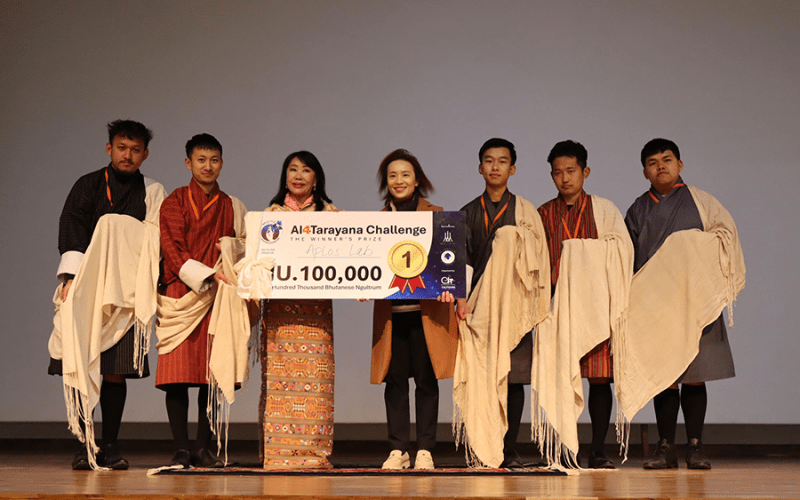
Students of Gyalpozhing College of Information and Technology (GCIT) are turning to artificial intelligence (AI) to tackle challenges faced by Bhutan’s rural communities. Their ideas took center stage at the AI4 Tarayana Challenge, a hackathon designed to promote inclusive, technology-driven solutions for the country’s most remote regions.
The event, which concluded yesterday in the presence of Her Majesty Queen Mother Dorji Wangmo Wangchuck, brought together 24 student teams. Each presented projects aimed at applying AI in ways that could make a tangible difference in rural livelihoods. After a competitive series of pitches, three teams advanced to the final round, showcasing solutions that blended technical ingenuity with local relevance.
Emerging as the winner was Aplos Lab, a team of fourth-year students who developed a multilingual AI model tailored to Bhutan’s diverse linguistic landscape. Their innovation focuses on enabling AI systems to understand and communicate in several local dialects, including Tshangla, Kurtoep, and Bumthap. The team walked away with the top prize of Nu 100,000.
“We wanted to contribute to preserving our dialects while making technology more accessible,” said Ugyen Dendup, co-founder of Aplos Lab. “The competition was intense, with many creative ideas. Winning was beyond our expectations.”
Second place went to MS Right, whose project addressed the pressing need for effective land and housing risk assessment tools in rural areas. Their AI-based system aims to help communities better evaluate environmental and structural risks—an area often overlooked due to limited resources and technical access.
Project lead Jamphel Yigzin Samdrup described the challenge as both complex and rewarding. “AI and rural settings don’t naturally align—there are constraints like limited infrastructure and data. But that pushed us to think differently and build something practical from the ground up,” he said.
Taking third place was Mebar Lab, a newly formed team of first- and second-year students. Their project, Lhakgay: Reading App, targets disparities in literacy levels between urban and rural students. By leveraging AI, the app seeks to support reading development in underserved communities.
“We only came together a week ago and didn’t expect to make it this far,” said team lead Tashi Tshering. “Being among the top three is incredibly motivating, and we hope to continue participating in hackathons and eventually launch our own startup.”
The AI4 Tarayana Challenge is part of the broader Tech Tarayana Collaboration, a joint initiative between GCIT and the Tarayana Foundation introduced last year. Supported by Bhutan Insurance Limited and Bond Capital Singapore, the program aims to encourage youth-led innovation with a focus on community impact.
As interest in AI continues to grow among Bhutan’s youth, events like this highlight a promising shift—one where cutting-edge technology is not just advancing industries, but also addressing grassroots challenges. By grounding innovation in local needs, these young developers are helping to ensure that the benefits of AI reach even the most remote corners of the country.


