


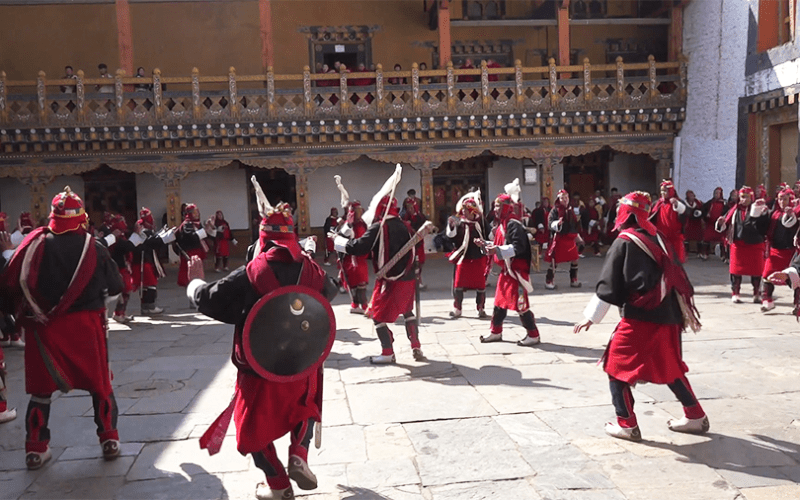
In an age when global trends and modern lifestyles increasingly shape the aspirations of young people, safeguarding Bhutan’s lesser-known traditions has become both a challenge and a responsibility. Nowhere is this more evident than in Punakha, where community leaders and elders are working deliberately to ensure that the centuries-old pazap tradition remains relevant for a new generation.
At the heart of these efforts is the annual Punakha Dromchhoe, a three-day festival held at the majestic Punakha Dzong. The event commemorates Bhutan’s historic victory over Tibetan forces in the 17th century under the leadership of Zhabdrung Ngawang Namgyal. Central to the celebration are the pazaps — lay warriors who reenact the battle in full traditional attire.
Each year, nine gewogs from Punakha and Thimphu select 18 pazaps to represent their communities. Dressed in warrior gho, leather boots and distinctive hats, swords in hand, they move in synchronised formations across the courtyard, evoking the discipline and courage of Bhutan’s defenders of old.
From Obligation to Inspiration
Historically, becoming a pazap was no small matter. Only men considered physically strong, commanding in presence and capable of reciting the zhey — the traditional warrior chant — were chosen. In earlier times, households were even required to provide a man to serve if numbers fell short.
Today, that rigid approach has softened. Rather than mandating participation, local leaders are actively encouraging young boys to volunteer, believing that early exposure will cultivate pride and long-term commitment.
Punakha Dzongkhag Tshogdu Chairperson Sonam Dorji said involving youth is essential for the future of Wang Tshogchen Gye. Allowing young people to take part, he said, motivates them and strengthens the likelihood that the tradition will endure.
The results of this shift are already visible.
A Nine-Year-Old Among Warriors
Nine-year-old Tshering Samdrup from Kabisa Gewog stood out this year as the youngest pazap at the festival. Fascinated by the warriors since childhood — their commanding movements, elaborate attire and sense of purpose — he long dreamed of joining their ranks.
This year, he did.
Under the guidance of senior pazaps, Tshering trained for weeks before the festival, practising each movement late into the evening. When the day arrived, he donned the warrior gho, secured his boots, fixed his hat firmly in place and grasped his sword with determination.
At the Gora, he swung the blade confidently, moving in rhythm with the elders beside him, embodying a spirit far older than his years.
“I enjoyed taking part in the Pazap performance,” Tshering said. “I volunteered to join and did not feel nervous around the seniors. I plan to participate again next year.”
Youth Taking Responsibility
Fourteen-year-old Tandin Wangchuk from Maedwang Gewog in Thimphu also stepped forward voluntarily, motivated in part by a shortage of participants. Without even consulting his parents, he made the decision to join.
He described the experience as transformative, saying interaction with senior pazaps strengthened both his skills and confidence. He hopes to continue participating in future festivals, school commitments permitting.
This year, nearly half of the 160 pazaps from Wang Tshochen Gye and Lingmukha Gewog were youth — a promising sign for those concerned about continuity.
Kinley Wangchuk from Barp Gewog, now in his second year as a pazap, said preserving culture depends largely on mindset. Active participation, he explained, makes the experience enjoyable and educational. Learning the songs and marching out through the main entrance carrying the Tsendhar fills him with pride.
Another senior pazap, Dophu, said seeing young trainees practise under experienced mentors gives him confidence that knowledge will be passed down faithfully.
Concerns Remain
Despite these positive developments, some elders remain cautious.
Sixty-eight-year-old Zhepeon Kinley, who can recite the entire zhey from memory, worries that few young participants are dedicating themselves to mastering the lengthy chants — an essential element of the tradition.
“This heritage should not be discarded,” he said. “Even as development brings new influences, Pazap culture remains important because it was inspired by the vision of Zhabdrung Ngawang Namgyal. We must continue to promote and preserve it.”
For Kinley, the challenge is not just participation but depth — ensuring that future generations carry not only the sword and costume, but also the knowledge and spirit behind them.
Carrying the Legacy Forward
As the final day of Punakha Dromchhoe concluded and crowds slowly dispersed from Punakha Dzong, the echo of drums and chants lingered in the crisp valley air. Among the departing spectators were proud parents, watchful elders and young boys already dreaming of next year’s performance.
In Punakha, the pazap tradition may be centuries old, but its future now rests in youthful hands — hands that have begun, with quiet determination, to grip the sword of heritage and carry it forward.


