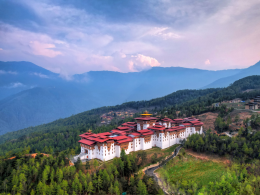
For nearly four centuries, Bhutan’s spiritual calendar has been marked by a sacred movement between two dzongs and two valleys. Every winter, the Central Monastic Body (Zhung Dratshang) makes its way to Punakha, its warm winter residence. When summer arrives, it returns to Thimphu’s Tashichhodzong. This sacred journey has been an unbroken tradition dating back to the 17th century.
This seasonal migration was established by Zhabdrung Ngawang Namgyel, the founder of Bhutan’s dual system of governance. Not even the Covid-19 pandemic disrupted this ritual, which has continued without interruption since its inception.
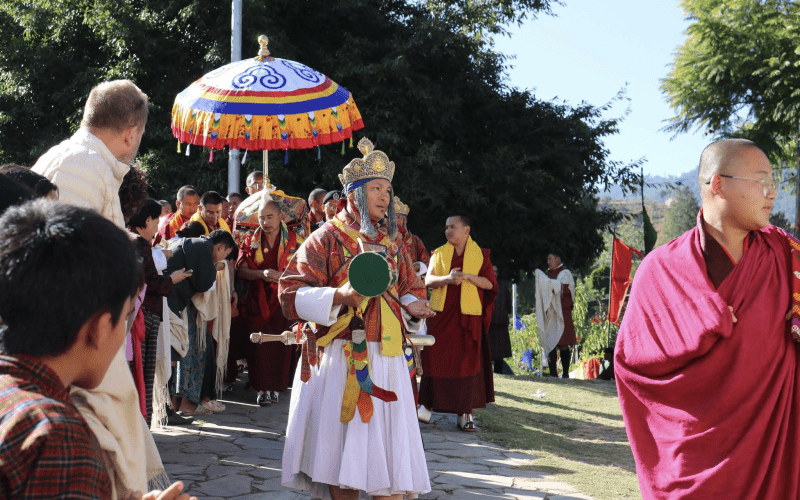
As the monks begin their journey toward Punakha, the highway fills with hundreds of students, devotees, and followers. They line the road to receive blessings, offer prayers, and pay homage as the crimson procession moves slowly along the valley.
The movement is precise, anchored to Bhutan’s lunar calendar. The monks begin their descent on the first day of the tenth Bhutanese month and spend six months in Punakha before making the return journey on the first day of the fourth Bhutanese lunar month. The migration reflects a practical consideration: Punakha’s subtropical climate provides warmth during winter, while Thimphu offers a cooler environment during the summer.
Yet the journey is far more than a response to climate. It is a ceremonial procession led by the Dorji Lopen, who oversees the carriage of sacred relics and religious treasures. All relics travel with the group except one—the Rangjung Kharsapani—which remains enshrined permanently in Punakha Dzong.
In earlier times, the monks traveled for three days, halting at Hongtsho and Thinleygang due to the absence of roads. Today, the journey takes two days, with a single halt at Thinleygang Goemba, a sacred temple founded in the 18th century by Zhabdrung Jigme Chogyal.
Though a road now connects the two dzongs in just a few hours, the monastic body preserves the measured pace. The deliberate slowdown allows communities along the route to approach, receive blessings, and renew their spiritual connection with the Sangha.
The return journey to Thimphu pauses at Simtokha Dzong, Bhutan’s oldest fortress, built by the Zhabdrung in 1629. Its strategic and spiritual significance makes it an enduring gateway to the capital and a living reminder of Bhutan’s historical roots.
The Central Monastic Body itself was formalised in 1621 when Zhabdrung Ngawang Namgyel established the first organised Sangha at Cheri with 30 novices. By 1637, its strength had grown to 600 monks, marking Punakha Dzong as its winter home. Today, it remains an autonomous institution funded by the State, headed by His Holiness the Je Khenpo.
The current Je Khenpo, His Holiness Tulku Jigme Chhoeda, has been the nation’s spiritual leader since 1996, supported by the Supreme Sangha Council.
As the monks walk between seasons, their movement becomes a living bridge between Bhutan’s past and present. It is a reminder that faith here is not confined to temples or texts—it travels, blesses, and endures, like the rivers that flow beside the two dzongs, carrying history forward with every step.