


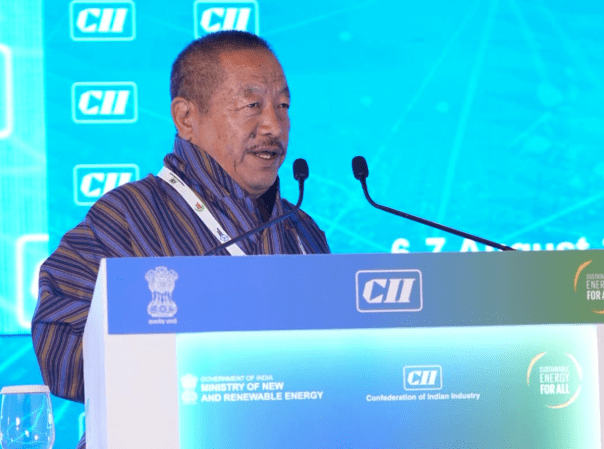
For more than half a century, energy has provided both an economic foundation and a powerful expression of the relationship between Bhutan and India. What began as cooperation in hydropower has gradually developed into one of South Asia’s most enduring examples of cross-border energy partnership.
Speaking at the inaugural session of the 7th CII International Energy Conference & Exhibition in India, Bhutan’s Minister of Energy and Natural Resources, H.E. Lyonpo Gem Tshering, captured this continuity succinctly: “Bhutan and India enjoy a relationship. We are together in the power sector, particularly. Cooperation started five decades ago. We have a well 5 year power plan. Energy trade has been the cornerstone of our bilateral relationship.”
The significance of those words extends beyond the electricity that crosses the border. They point to an economic relationship in which Bhutan’s natural resources, India’s enormous energy market and the development priorities of the two countries have increasingly become complementary.
For Bhutan, the question now is how this established energy partnership can become the foundation of the country’s next phase of economic development.
Hydropower as an Economic Partnership
Bhutan’s rivers have long been among its most important economic assets. Hydropower development has enabled the country to convert this natural endowment into electricity for domestic consumption and export, particularly to India.
The importance of this arrangement lies in its underlying complementarity. Bhutan possesses substantial renewable-energy potential relative to the size of its domestic economy, while India has a vast and growing requirement for reliable energy. Electricity trade therefore allows Bhutan to participate in a much larger market than its population alone could provide.
But the value of energy cooperation cannot be measured solely in megawatts.
Investment in power projects creates infrastructure, generates employment, develops technical capabilities and produces revenues that can support wider national development. Roads, transmission systems and associated infrastructure built around energy projects can also improve connectivity and create opportunities for economic activity beyond the power sector itself.
Energy cooperation should therefore be understood not merely as an export arrangement, but as part of Bhutan’s development architecture.
The Next Chapter Must Be Broader
The global energy landscape, however, is changing rapidly.
Countries are moving towards increasingly diversified renewable-energy systems. Solar generation, energy storage, smarter transmission networks, electric mobility and new forms of green industry are becoming important components of national energy strategies.
This transformation presents Bhutan with an opportunity.
The next generation of India–Bhutan energy cooperation need not replace hydropower; rather, it can build upon it.
Bhutan’s hydropower resources offer an important advantage precisely because renewable-energy systems increasingly require flexibility. Solar and wind generation fluctuate according to weather and time of day. Hydropower, particularly when supported by appropriate storage and grid infrastructure, can complement these variable sources.
Bhutan can consequently position itself not simply as an exporter of electricity but as a strategically important participant in a more integrated regional clean-energy system.
Such a transition would also open possibilities for cooperation in solar energy, energy storage, transmission infrastructure, green technologies and potentially new electricity-intensive industries.
From Electricity Exports to Economic Transformation
The larger policy objective for Bhutan should be to ensure that energy development creates increasingly broad economic benefits within the country.
Export revenues remain important, but electricity can also become an input into new domestic industries.
Reliable renewable power can help Bhutan attract enterprises for which clean energy is increasingly an economic advantage. As companies around the world seek to reduce the carbon intensity of their operations and supply chains, countries capable of providing dependable renewable electricity could acquire a new competitive edge.
Bhutan should examine where this advantage can realistically support industries compatible with the country’s economic scale, environmental commitments and development philosophy.
The objective should not be industrialisation at any cost. It should be high-value, low-impact economic development built around Bhutan’s renewable-energy advantage.
This could also help address one of Bhutan’s persistent economic challenges: creating attractive opportunities for its young and increasingly educated population.
A more sophisticated energy economy requires engineers, technicians, project managers, financial specialists, researchers, environmental experts and entrepreneurs. Developing these capabilities would allow Bhutanese citizens to participate not only in the construction of energy infrastructure but increasingly in its design, management, financing and technological evolution.
Energy policy, in other words, can also become human-capital policy.
India’s Energy Transition Creates an Opportunity
The timing is significant because India itself is undergoing a major energy transition.
The scale of the Indian economy means that changes in its electricity system will inevitably influence the regional energy landscape. Growing renewable generation will require stronger transmission systems, greater flexibility and increasingly sophisticated mechanisms for moving electricity across regions and across time.
For Bhutan, geographical proximity to such a large energy market remains an extraordinary economic advantage.
For India, Bhutan offers something equally valuable: a trusted neighbour with substantial renewable-energy resources and decades of experience in cross-border electricity cooperation.
This is why the durability of the relationship matters.
Energy projects are inherently long-term. They require large investments, complex infrastructure and confidence that agreements will survive political and economic cycles. Five decades of cooperation have created institutional knowledge and mutual familiarity that cannot easily be replicated.
The challenge now is to use that accumulated trust to design the next fifty years of cooperation rather than merely continuing the arrangements of the previous fifty.
A Partnership That Must Continue to Evolve
Future projects must naturally remain commercially sound, environmentally responsible and sensitive to Bhutan’s national priorities.
Large infrastructure projects inevitably raise questions about financing, debt, environmental impact, project timelines and the distribution of economic benefits. A mature partnership should not avoid such questions. It should develop institutions capable of addressing them transparently.
Bhutan must also preserve the environmental values that distinguish its development model. Renewable energy should reinforce, rather than weaken, the country’s commitment to ecological stewardship.
The strongest India–Bhutan energy partnership will therefore be one in which economic viability, environmental responsibility and national development objectives reinforce one another.
Long-term planning becomes particularly important in this context. The reference by Lyonpo Gem Tshering to a five-year power plan signals the importance of moving beyond individual projects towards a coordinated vision of generation, transmission, trade and domestic consumption.
Such planning should increasingly ask not only how much electricity Bhutan can generate, but how electricity can create the greatest economic value for Bhutan.
That distinction will define the next stage of the country’s energy journey.
From Cornerstone to Catalyst
Energy trade has rightly been described as the cornerstone of India–Bhutan relations. But a cornerstone is ultimately valuable because of what can be built upon it.
Five decades of cooperation have already demonstrated that geography and natural resources can be transformed into mutually beneficial economic partnership. The coming decades provide an opportunity to take that model further.
Hydropower can remain central while becoming part of a wider ecosystem encompassing renewable integration, storage, modern grids, technology, skills and new forms of green enterprise.
For Bhutan, the ultimate measure of success will not simply be the amount of electricity exported across its southern border. It will be the extent to which the energy sector creates prosperity within Bhutan — generating productive employment, strengthening national capabilities, supporting fiscal stability and opening new opportunities for future generations.
India and Bhutan already possess something unusually valuable in international energy relations: fifty years of experience working together.
The task before both countries is to turn that inheritance into an equally ambitious partnership for the next fifty.
If that happens, energy will remain more than the cornerstone of bilateral relations.
It can become one of the principal catalysts of Bhutan’s next development story.


