

While citrus greening disease has pushed many farmers in different parts of the country to shift from orange cultivation to other cash crops, residents of Berdungma village in Trashigang continue to depend on the fruit as their primary livelihood.
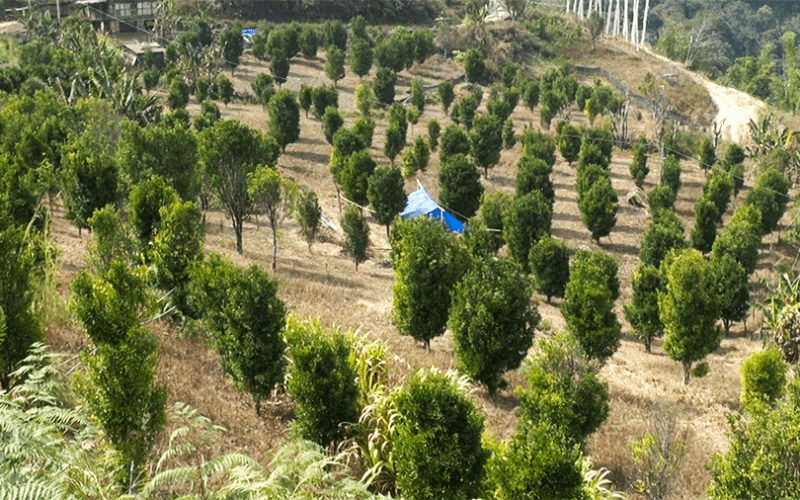
Located in one of the most remote parts of Thrimshing Gewog, Berdungma remains strongly tied to orange cultivation, with the fruit providing the main source of income for most households.
Although the harvesting season has recently concluded, farmers in the village remain busy tending to their orchards. They are clearing bushes around the trees, applying manure, and carrying out other maintenance work to prepare for the next fruiting season. Villagers say these efforts are essential to ensure better yields in the coming harvest.
Orange cultivation has been practiced in the village for more than a decade, but farmers began focusing more seriously on the crop about five years ago after they started earning significant income from it.
Today, most households own around 100 orange trees on average. Some families manage more than 400 trees, allowing them to earn over Nu 100,000 annually from orange sales.
Thinley Wangdi, a farmer from Berdungma, said that villagers continue to expand their orchards by planting new saplings each year.
“Every year, we plant new orange saplings because oranges have become an important source of income for us. Earlier, we used to cultivate potatoes but it no longer grows well here. Most farmers earn between Nu 100,000 and Nu 200,000 a year from oranges, and a few farmers even earned more than Nu 300,000 last year,” he said.
For many families, the income from oranges helps meet essential household expenses. Dorji Dema, another farmer from the village, said the earnings support their children’s education and daily needs.
“Compared to earlier, we are earning a better income now. We use the money to support our children’s education, as they are still studying. It also helps us cover our daily expenses and pay taxes in the village. At the moment, oranges are our only source of income,” she said.
Farmers from Berdungma mainly sell their oranges in Samdrup Jongkhar, with most of the produce sold directly from the village.
According to Thungkhar, the Berdungma Chiwog Tshogpa, a proposal has been submitted to secure a budget in the next financial year to provide additional orange saplings to farmers.
Last year, around 45 households in Berdungma produced approximately 60 metric tonnes of oranges.
Within Trashigang Dzongkhag, Thrimshing Gewog is the second-largest orange producing area after Yangnyer Gewog, highlighting the growing importance of citrus cultivation in the region.


