


The agriculture sector has emerged as a key driver of economic growth, contributing more than Nu 39.6 billion to the national economy last year—marking a significant step toward its long-term goals. This figure represents roughly 75 percent of the ministry’s target to reach Nu 50 billion in Gross Domestic Product (GDP) contribution by 2029.
Officials from the Ministry of Agriculture and Livestock credit the impressive performance to a combination of improved productivity, diversification of agricultural products, and expanding export markets. The sector’s contribution rose sharply from just over Nu 31 billion in 2023, reflecting an increase of nearly Nu 8.5 billion within a year.
High-value crops played a crucial role in this surge. Cardamom, oranges, and potatoes alone generated close to Nu 3.95 billion in 2025, highlighting the growing importance of export-oriented agriculture. In addition, production gains were recorded in maize, organic asparagus, and mushrooms, indicating a broader shift toward diversified farming.
According to the ministry’s Mid-Term Review, targeted interventions such as expanded chain-link fencing and the introduction of improved seed varieties have helped farmers boost yields. Encouraged by these results, the government is now considering revising some production targets upward.
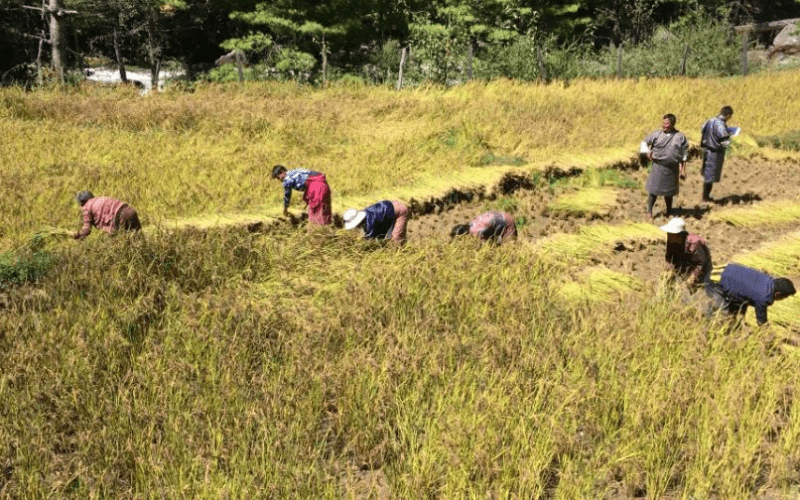
However, not all areas met expectations. Several key commodities fell short of their planned outputs under the current Five-Year Plan. Paddy production reached approximately 45,530 metric tonnes, missing the target of over 54,000 metric tonnes. Similarly, quinoa production stood at just 39 metric tonnes against a goal of 250, while fish production reached 47.4 metric tonnes—also well below its target.
In response, the ministry has proposed revising these targets to more realistic levels. The proposals are currently under review by the Office of the Cabinet Affairs and Strategic Coordination, along with the Ministry of Finance.
Despite the positive growth trajectory, the sector continues to face structural challenges. These include the loss of agricultural land, rising production costs, the impacts of climate change, and a shortage of skilled labor.
To address these issues and sustain momentum, several supportive initiatives are in the pipeline. These include expanding access to credit, introducing crop and livestock insurance schemes, implementing biodiversity action plans, and strengthening farmer networks through linkages with Gyalsung academies.
During the Mid-Term Review, the Prime Minister emphasized the need for stronger coordination among ministries and a sharper focus on implementation. Achieving national goals under the GMC, the 10X Economic Vision, and the Diamond Strategy, he noted, will depend on a unified and results-driven approach.
As the agriculture sector continues to evolve, its performance will remain critical not only for economic growth but also for rural livelihoods and national food security.


