In a region where the teachings of the Buddha continue to shape daily life, a small school in India is demonstrating how compassion can be lived, not just taught.
At Maitreya Universal Education School in Bodh Gaya, Bihar—near the site of the Buddha’s enlightenment—education is being reimagined through the lens of compassion, a core principle in Buddhism and one deeply familiar to Bhutanese society. Over the past year, the school has made notable progress following support from the Foundation for the Preservation of the Mahayana Tradition, but it is the spirit behind these changes that stands out most.
Compassion here is not confined to prayer halls or moral instruction. It is woven into the daily rhythm of school life. For many students, who come from families facing poverty, instability, or hardship, the first experience of compassion is simple but profound: a safe classroom, a caring teacher, and a nourishing meal.
The restoration of the school’s morning nutrition program has become one of its most meaningful initiatives. Children who once arrived hungry now receive basic food—bananas, peanuts, and boiled eggs—allowing them to focus and engage. In Buddhist thought, compassion often begins with meeting immediate suffering, and here that principle is put into action.
The school, run by the Root Institute for Wisdom Culture, follows the vision of Lama Zopa Rinpoche, who believed education should nurture kind-hearted individuals capable of bringing peace to the world. His vision resonates strongly with Bhutan’s own emphasis on values-based education and collective well-being.
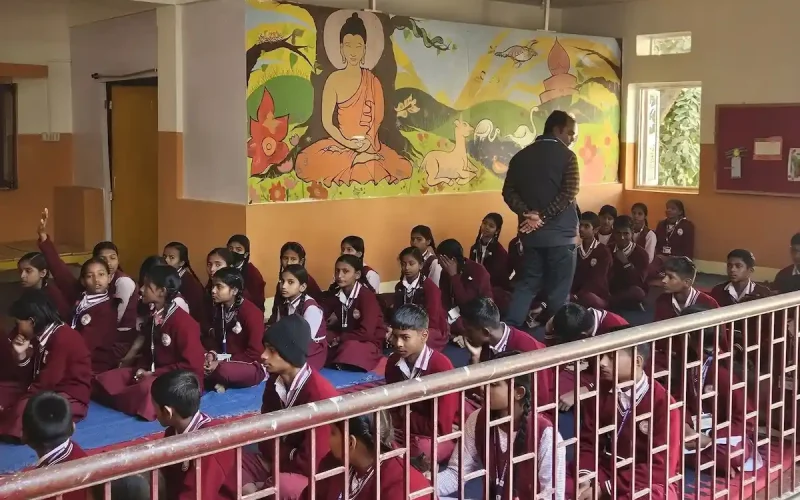
In classrooms, compassion takes the form of understanding the emotional lives of children. Teachers have adopted trauma-informed methods, recognizing that many students carry unseen burdens. Younger children now remain with a single teacher throughout the day, building trust and stability—an approach that reflects the Buddhist emphasis on mindfulness and care in relationships.
Another practice, known as “circle time,” invites students to sit together in small groups and reflect on the school’s “16 Guidelines for Life.” These discussions encourage empathy, honesty, and responsibility. Rather than memorizing moral lessons, students are guided to experience and express them—learning compassion through interaction.
Meditation and art therapy also play a role, helping children develop awareness of their thoughts and emotions. Such practices echo long-standing Buddhist traditions, where cultivating inner calm is seen as the foundation for compassionate action.
Even the physical environment reflects this ethos. The school is expanding spaces for music, dance, and creative expression, while gardens are being developed as places for ecological learning. The library, rebuilt with the help of volunteers, has become a sanctuary of quiet reflection and imagination, filled with books that open new worlds to young readers.
Importantly, students are growing up in direct contact with sacred Buddhist heritage. Visits to the Mahabodhi Temple and nearby pilgrimage sites such as Rajgir and Nalanda allow them to connect their daily learning with the life and teachings of the Buddha. These experiences reinforce the idea that compassion is not abstract, but something to be practiced in the world.
The school’s efforts have drawn attention from figures such as Geshe Lhakdor, who has emphasized that true devotion lies in helping others, especially those in need.
Challenges remain, including limited resources and difficulty retaining teachers. Yet the school’s steady progress suggests that compassion, when applied consistently, can be transformative.
Supported by the FPMT Social Services Fund, Maitreya Universal Education School is quietly embodying a principle at the heart of Buddhism: that genuine compassion is not only a value to be taught, but a practice that can change lives.