


At first glance, the gallery feels like any other—quiet, contemplative, filled with curious onlookers. But within moments, something shifts. Visitors hesitate, then reach out. Fingers brush against an unusual sculptural form. A soft musical note rises in response. The artwork is no longer just an object. It is alive.
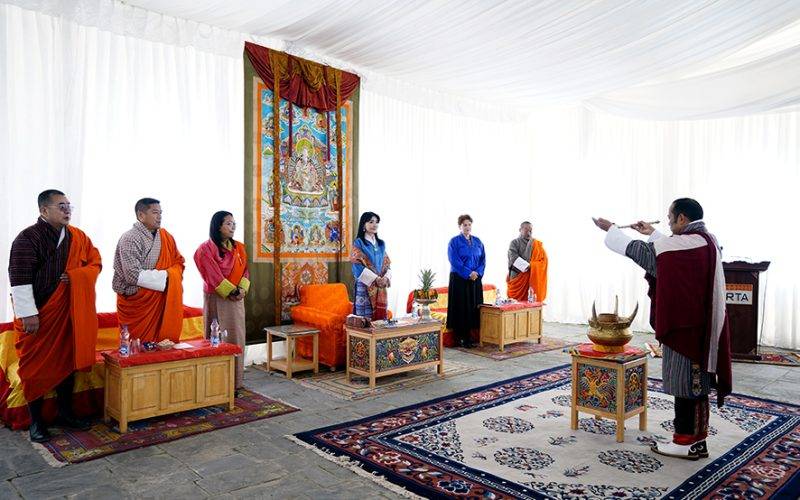
This is the experience greeting audiences at the Lithuanian Textile Script Exhibition, which opened today under the patronage of Queen Mother Sangay Choden Wangchuck. Designed to showcase Lithuanian creativity while fostering cultural exchange, the exhibition offers more than visual delight—it invites a deeper, more intimate engagement.
At the heart of the show is an installation by Lithuanian artist Gerda Liudvinavičiūtė, a work that challenges the very notion of how art should be experienced. Rather than standing back and observing, visitors are encouraged to step forward and touch.
The piece, resembling a large ritual ornament, responds to human contact. Each interaction triggers subtle changes—gentle sounds, shifting sensations—transforming the sculpture into what feels like a responsive, almost sentient body. It is not merely seen; it is felt.
For Liudvinavičiūtė, this tactile dimension is central to her artistic vision. She describes the human body itself as a kind of textile—layered, complex, and deeply interconnected. “Our skin is a textile, it’s a layer,” she explains. “A human has many layers—emotional, physical, and internal systems like nerves. I wanted to explore how we can interpret textiles through the human body in a contemporary way.”
The installation goes beyond sensory novelty. It reflects a broader idea: that the human body exists as part of a living ecosystem, intertwined with other forms of life and matter. Each touch becomes a reminder of relationships—between people, and between humanity and the more-than-human world.
In a time when communication is increasingly mediated by screens, the work carries a quiet but urgent message. “We forget about the energy between people,” Liudvinavičiūtė notes. “Digital communication is different from seeing someone, looking into their eyes, and feeling presence through touch.”
That sentiment resonates strongly within the exhibition space. Visitors linger longer than usual, returning to the piece, experimenting with contact, sharing the experience with others. There is a sense of rediscovery—of something simple, yet profound.
Titled Embodied Wandering, the installation does not overwhelm with complexity. Instead, it offers a gentle invitation: to move beyond words, beyond observation, and into sensation. To remember that connection is not only seen or spoken—but felt.
In this shared space of presence and touch, the artwork quietly asks a question that lingers long after visitors leave: in a world of distance and distraction, what does it mean to truly connect?


