


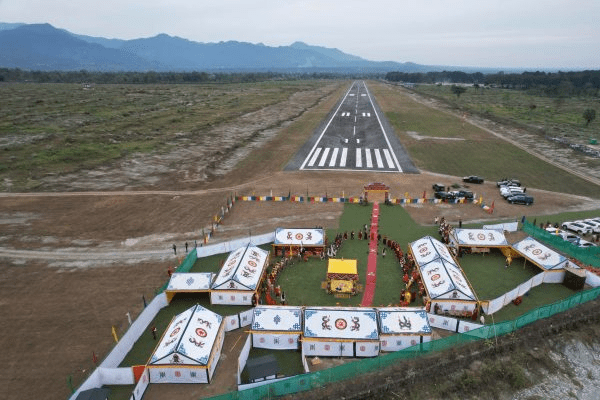
As Bhutan’s ambitious Gelephu Mindfulness City (GMC) transitions from visionary concept to active development, a leading Thai financial expert has highlighted its vast potential across multiple high-growth sectors, positioning the project as a compelling destination for regional investors.
Dr. Arak Sutivong, a prominent figure in Thailand’s banking and financial services industry, recently joined a delegation of over 20 high-net-worth individuals on a site visit to GMC. The group toured ongoing developments, engaged with project leadership, and gained firsthand insight into the city’s progress.
“I see plenty of them,” Dr. Sutivong remarked when asked about investment prospects. “We see opportunities across many areas such as wellness, hospitality, recreational work, live-in-play environments, and high-tech sectors.”
GMC, a flagship initiative championed by Bhutan’s leadership, aims to create a sustainable, forward-looking economic zone that blends mindfulness principles with modern innovation. Backed by abundant hydropower and a strong commitment to carbon-negative operations, the city is particularly well-suited for data centres, green technology ventures, and advanced digital infrastructure.
Discussions during the visit centred on key priority areas including wellness and medical services, hospitality, infrastructure development, and emerging digital industries. These sectors align closely with the strengths of Thai and broader Southeast Asian investors, opening doors for cross-border collaboration and long-term partnerships.
Investors expressed enthusiasm not only for potential financial returns but also for the opportunity to support Bhutan’s broader development goals. “This is a great opportunity to come and visit firsthand to see not only the vision but to see the execution,” Dr. Sutivong noted, praising the commitment and vision driving the project.
Another Thai delegate, Phumiphan Bunjapamai, founder of the Nuttabhum Foundation, echoed the sentiment: “As Thai people, we love His Majesty very much. We admire his work, and it inspires us. We would like to volunteer ourselves in helping him to achieve what he wants to do here in GMC.”
Strategically located in southern Bhutan, GMC is envisioned as a vital bridge connecting South and Southeast Asia. Its success will depend on timely infrastructure rollout, including a planned airport targeted for 2029, robust logistics networks, and clear policy frameworks that provide transparency and stability for investors.
Project authorities are actively addressing these needs, with detailed roadmaps and sector-specific pipelines expected to be shared soon. Dr. Sutivong emphasised that while the vision is inspiring, “clarity in the details, execution, implementation, and roadmap” will be crucial to attracting sustained investment.
As GMC moves into its implementation phase, the growing interest from Thai and international investors signals strong confidence in its potential to drive economic growth while remaining true to principles of sustainability and mindful development. For Bhutan, the project represents more than an economic zone — it is a bold step towards a diversified, future-ready economy that could serve as a model for the region.
With bilateral ties between Bhutan and Thailand already warm, initiatives like GMC are poised to deepen economic and cultural exchanges, promising mutual benefits in the years ahead.


