


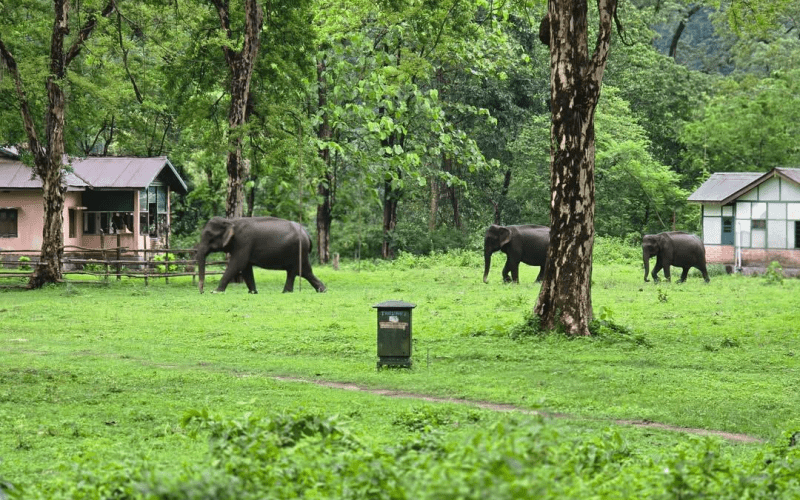
Deep in southern Bhutan, where dense forests meet winding rivers and mist-covered hills, the small town of Panbang is quietly rewriting its future. Once dependent on clearing forests to survive, the community is now turning toward conservation and eco-tourism as a path to prosperity — a transformation that reflects both resilience and vision.
For decades, life in Panbang was defined by isolation. Roads were few, markets were distant, and economic opportunities were scarce. Families relied heavily on the surrounding forests for farmland, timber and fuel. Yet the very remoteness that once held the region back has today become one of its greatest strengths.
Nestled within the ecologically rich Greater Manas Landscape, Panbang remains one of Bhutan’s most biodiverse regions. Thick forests shelter rare wildlife, pristine rivers cut through untouched valleys, and the natural environment has survived largely because development arrived slowly. What was once considered a disadvantage is now drawing the attention of travelers seeking authentic eco-tourism experiences.
The roots of Panbang’s agricultural story also carry an international connection. Residents still remember the work of Dasho Keiji Nishioka, the Japanese agricultural expert who played a pioneering role in introducing modern farming practices to Bhutan. His efforts helped rural communities improve cultivation methods and food production during a critical period in the country’s development. In Panbang, his legacy remains tied to the idea that progress can be achieved while respecting the land.
Today, a new generation is building on that philosophy.
Local groups such as the River Guides of Panbang are creating opportunities that depend not on exploiting the forest, but on protecting it. By guiding visitors along the region’s rivers and wilderness trails, they are generating income while showcasing the area’s extraordinary biodiversity. These initiatives are also helping young people remain in their communities instead of migrating elsewhere in search of work.
Community leaders and entrepreneurs have become central to this transition. Figures like Ugyen Tshering, along with eco-lodge owners across the region, are helping establish the foundations of a sustainable tourism economy. Their efforts range from promoting responsible travel to creating accommodation that blends with the natural environment rather than replacing it.
For many residents, eco-tourism is no longer simply an alternative industry — it is becoming a survival strategy. Protecting forests now means protecting livelihoods. The community increasingly understands that the rivers, wildlife and landscapes surrounding Panbang are assets far more valuable standing than cleared.
The future of the region is also closely linked to Bhutan’s ambitious Gelephu Mindfulness City vision, which aims to balance economic growth with environmental and cultural preservation. As Bhutan explores new development pathways, Panbang may offer a powerful example of how rural communities can adapt without sacrificing the ecosystems that define them.
In the land of the Khengpas, the forest is more than scenery. It is identity, protection and hope for generations to come. And as Panbang embraces eco-tourism, the community is sending a clear message: survival and conservation no longer stand in opposition — they now depend on each other.


