


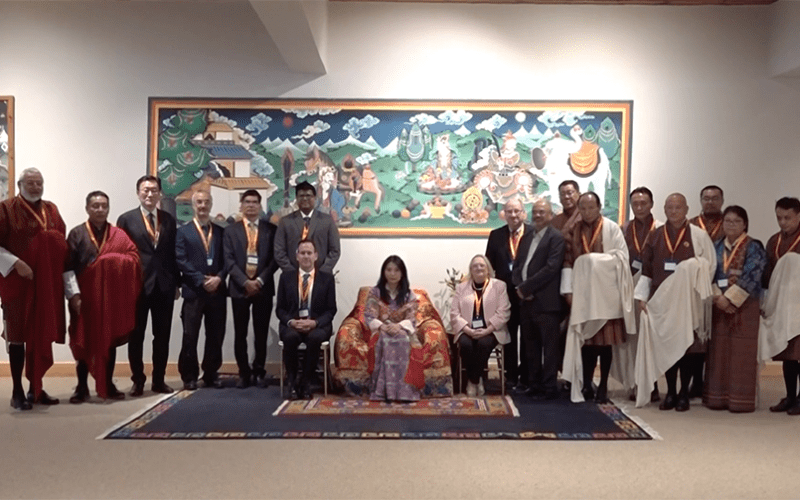
Bhutan has taken a significant step towards strengthening its digital future with the launch of the Engineering Education, Research and Innovation Summit, a two-day international gathering that opened in Paro yesterday. The event is being organised in collaboration with the Institute of Electrical and Electronics Engineers (IEEE), a leading global technology and engineering organisation headquartered in the United States.
The summit has brought together academics, technology experts, researchers and policymakers from around the world to examine how engineering education can contribute to Bhutan’s digital transformation and long-term sustainable development aspirations.
Her Royal Highness Princess Chimi Yangzom Wangchuck graced the opening ceremony and underscored the importance of ensuring that technological progress remains firmly rooted in Bhutan’s values. Addressing participants, Her Royal Highness highlighted the need to align innovation with the principles of Gross National Happiness, stressing that advances in technology should enhance well-being, inclusivity and sustainability.
“The question before us is not whether technology will shape the future, it certainly will,” Her Royal Highness said. “The more pressing question is whether we can shape technology according to our values. Can innovation advance human well-being? Can artificial intelligence support inclusion and opportunity? Can progress remain sustainable and compassionate? These are questions that deeply align with Bhutan’s philosophy of Gross National Happiness.”
Discussions during the summit are centred on preparing Bhutan’s education system for the demands of a rapidly evolving digital landscape. Participants are exploring strategies to modernise engineering curricula, strengthen research capabilities and equip students with practical skills needed in emerging fields such as artificial intelligence and advanced technologies.
A major theme of the event is the shift from traditional theory-based learning towards hands-on, application-driven education that better reflects industry requirements and the realities of a modern digital economy.
The summit is also examining ways to strengthen research ecosystems within universities, promote international academic partnerships and address infrastructure challenges that continue to affect equitable access to digital technologies across the country.
Speaking at the event, IEEE President and Chief Executive Officer Mary Ellen Randall praised Bhutan’s efforts to integrate practical learning and environmental responsibility into its educational programmes.
“A lot of the educational programmes that you are promoting have practical applications. They are very environmentally friendly. You have experiential education built into the system already,” she said. “People are looking at real-world problems. All those things are going to make engineers for the future, and it is happening today.”
As part of its collaboration with Bhutan, IEEE announced a six-month complimentary access package to a range of its digital knowledge resources. The initiative includes access to the IEEE Xplore Digital Library, which contains more than seven million technical documents, journals, conference papers and standards. Bhutanese institutions will also gain access to the IEEE eLearning Library, offering expert-led courses in engineering, computing and emerging technologies.
According to Randall, the partnership is designed to foster greater collaboration and knowledge sharing between Bhutan and the international engineering community.
“We bring people together to collaborate, challenge each other’s thinking and expand ideas about where we are going,” she said. “Sharing experiences and learning from one another will be beneficial for both sides.”
The summit will continue today with further sessions focused on innovation, engineering education reform, research partnerships and strategies to support Bhutan’s journey towards a digitally empowered future.


