


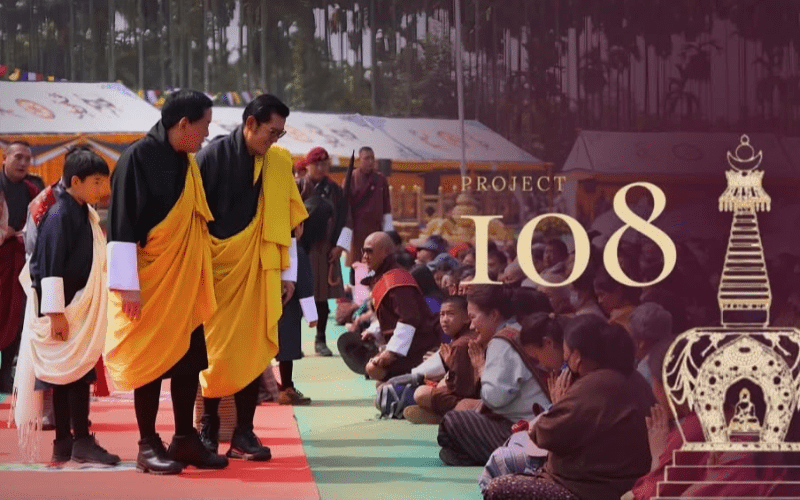
With less than two months remaining before 108 Jangchub Chortens are raised simultaneously in Gelephu Mindfulness City, Project 108 has already exceeded its volunteer target, shifting attention from attracting participants to managing one of the country’s largest coordinated volunteer efforts.
As of August 29, 48,389 people had registered to take part in the initiative, well above the initial requirement of 40,000 trained volunteers. Of them, 48,158 are Bhutanese. The registrations include 25,832 men and 22,557 women.
The figures mean that the challenge facing organisers is no longer finding enough people for the November 1 construction. It is ensuring that tens of thousands of participants, materials and support services reach the right places at the right time.
The 108 chortens will be constructed simultaneously along a stretch of more than 12 kilometres beside the Mau Chhu in Gelephu Mindfulness City (GMC).
If the original target of 40,000 volunteers were divided equally among the 108 sites, each chorten would have about 370 participants. At the current registration figure, that average increases to about 448 people.
The actual deployment, however, is expected to look different.
Not everyone taking part will be engaged in building the chortens. A mobilisation of this size will require volunteers for transportation, food, accommodation, logistics, site management and coordination, alongside those assigned to construction.
Unlike conventional construction projects, where work can be adjusted over weeks or months, Project 108 is centred on a single day. Teams at all 108 locations are expected to work concurrently to construct the external structures of the chortens.
This leaves little room for delays in the movement of people, equipment and construction materials. Volunteers will need to know their assigned sites and responsibilities, while materials and equipment will have to be positioned across the 12-kilometre project area before construction begins.
Accommodation is another part of the growing logistical exercise.
An open-space directory currently identifies 17 spaces with a combined capacity of 9,348 people. It shows 8,467 places as available and 881 as booked.
Several smaller sites have already reached capacity. The SSP site near Namkhaling, which accommodates 100 people, is fully booked, as is Lobzang near Tali Dratshang in Jampeling, with space for 500 people. The GICG Cricket Ground in the Tashiling ISC area, with a capacity of 200, is also full.
Other locations continue to have space, including the Karma site at Dolonggang in Dekiling Gewog, which can accommodate 500 people, and the Ganga site near Mao Khola in Gelephu Gewog, with capacity for 600.
Although the spaces listed in the directory may not all be exclusively designated for Project 108 participants, the figures provide an indication of the facilities being organised as the project approaches its construction date.
The mass participation draws on Bhutan’s tradition of zhabto, the voluntary contribution of labour towards religious and community activities. Project 108, however, is taking that tradition to an unusual scale, combining voluntary service with the logistical demands of coordinating almost 50,000 registered participants.
While preparations for the physical construction gather pace in GMC, another essential part of the project is unfolding more quietly at Sarpang Dzong.
Twenty Zung Lopens, supported by 60 monks, are preparing the Zung — the sacred contents that will eventually be placed within the 108 chortens.
Considered the “wisdom heart” of a stupa, the Zung gives the completed structure its sacred significance as an embodiment of the Buddha’s enlightened Body, Speech and Mind.
Central to it is the Sok Shing, or “Life Essence Tree”, a sacred wooden pillar placed along the central axis of the chorten. Around it are sacred texts and objects prepared according to Buddhist tradition.
Thousands of dharani mantras are being meticulously prepared and wound around incense sticks, while others are inscribed on saffron-dyed traditional paper. Sacred statues, precious relics and auspicious objects associated with prosperity and wellbeing also form part of the contents.
For the monastic community, the painstaking work is itself an offering. Each mantra and sacred object prepared at Sarpang Dzong contributes to the project’s larger aspiration for peace, compassion and the wellbeing of all sentient beings.
The work of the monks and that of the thousands of volunteers will eventually converge inside the completed structures: one giving the chortens their physical form and the other their sacred purpose.
Public participation in the initiative has not been limited to volunteering.
A crowdfunding campaign that closed on August 21 drew contributions from 7,823 donors. In Bhutan, 7,262 donors contributed Nu 28.34 million, while 561 donors abroad contributed USD 85,779.26.
Together, the fundraising and volunteer response show two distinct forms of public participation — those contributing financial resources and those preparing to contribute their time, skills and labour.
Project 108 was envisioned by His Majesty the King on February 21, coinciding with His Majesty’s birth anniversary. It seeks to construct 108 Jangchub Chortens, or Stupas of Enlightenment, as an offering for peace, compassion and the wellbeing of all sentient beings.
Each chorten will rise 15 metres and will be positioned 108 metres apart, centre to centre. The number 108 holds deep significance within Buddhist teachings and devotional traditions.
Preparatory work has been progressing for months. Designs and locations for the chortens have been confirmed, while engineering, foundation preparation and vendor sourcing have advanced under the guidance of Buddhist masters.
With November 1 drawing closer, the project is entering a decisive phase.
The initial challenge was to mobilise 40,000 trained volunteers. That target has already been surpassed by more than 8,000 registrations. The task now is to translate that response into an organised operation across 108 locations.
Doing so will require clear communication, carefully assigned responsibilities, transportation, accommodation and close coordination among construction teams and support services.
Yet the scale of Project 108 cannot be measured only by the number of people registered or the amount of money raised.
Behind the statistics are thousands of people offering money, time and labour, while monks work quietly to prepare the sacred contents that will eventually rest inside the structures.
When the 108 chortens begin rising along the Mau Chhu on November 1, they will be the visible culmination of months of preparation taking place across different parts of the country.
The enduring significance of Project 108 may therefore lie not only in the monuments that remain in Gelephu, but also in the collective effort that created them — bringing together voluntary labour, financial contribution, faith and a shared purpose on an unprecedented scale.


