


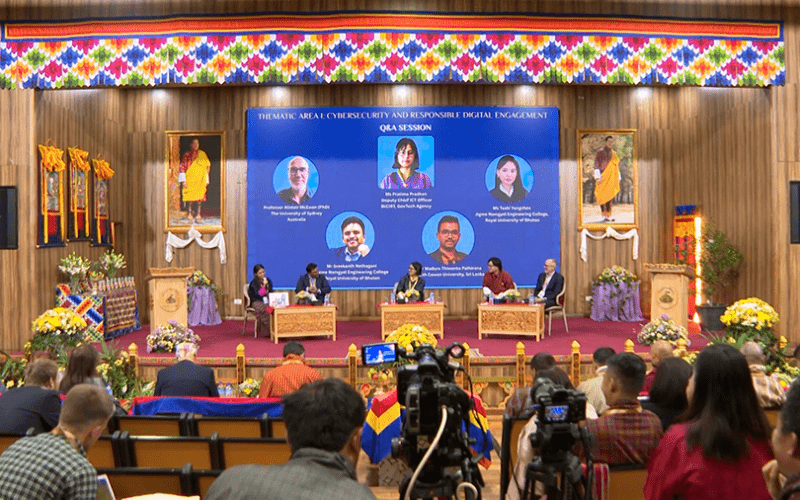
Bhutan and Australia deepened their long-standing academic and research ties today as the third edition of the Australia–Bhutan Research Conference opened in the capital. Bringing together more than 360 researchers, policymakers, and development practitioners from both nations, the gathering aims to advance collaborative research that can address some of the most pressing national and global issues.
Hosted in Bhutan for the first time—after earlier editions in Sydney and Perth—the conference represents a significant step toward strengthening institutional partnerships and expanding the scope of joint inquiry. This year’s theme, “Bridging Knowledge, Innovation, and Policy: Harnessing the Power of Research,” underscores a renewed commitment to connecting academic findings with real-world impact. The event also serves as a tribute to the 70th birthday of His Majesty the Fourth Druk Gyalpo.
Participants will deliver nearly 70 presentations, poster sessions, thematic discussions, and fireside dialogues. The topics span a broad spectrum: happiness and well-being, climate change, higher education, technology, governance, public policy, leadership, and emerging health-focused digital innovations.
Chewang Rinzin, Vice Chancellor of the Royal University of Bhutan, emphasised the need to translate research into meaningful action.
“It provides a platform for researchers and scholars to share knowledge, new ideas, and new insights,” he said. “We find that there is a wide gap between research and policymaking, between research and innovation, between research and business, and between research and community development. As a university, we need to find ways to bridge that gap between what we discover through research and what is applied in practice.”
Cybersecurity and responsible digital engagement featured prominently on the opening day, with experts calling for regular awareness programmes in schools to build digital resilience among young people. Another focal point was hydropower security—a sector vital to Bhutan and of growing interest to Australian researchers and policymakers.
Carly Partridge, Minister Counsellor at the Australian High Commission in Delhi, highlighted the diversity of research areas represented.
“There is such a wide variety of areas of research that are the focus of the conference,” she noted. “Some of them include hydropower, which is important for Bhutan. We have a paper examining medical and medical-related technologies, as well as governance. It’s a great opportunity for both Australia and Bhutan to focus on what we can learn from each other.”
Organised in partnership with the Royal Bhutanese Embassy in Canberra and supported by the Australian Government, the conference is expected to cultivate stronger academic networks and generate policy-relevant insights. As Bhutan hosts the conference for the first time, participants hope the gathering will lay the foundation for deeper collaboration, innovative research pathways, and a shared commitment to evidence-based decision making.


