


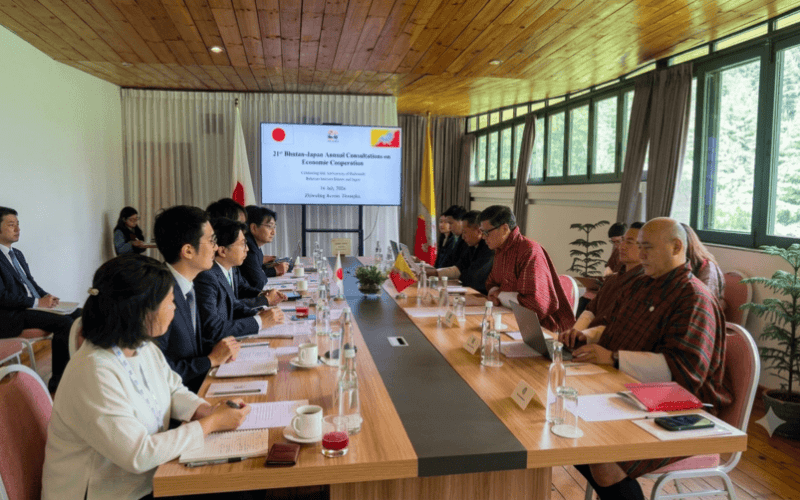
Thimphu: Bhutan and Japan have agreed to deepen cooperation in public health, education, agriculture, disaster preparedness and other development sectors as the two countries mark 40 years of diplomatic relations.
Officials from both sides reviewed ongoing projects and discussed future areas of collaboration during the 21st Bhutan-Japan Annual Consultation on Economic Cooperation, held in Thimphu on Thursday.
The annual dialogue, which has been held since 2006, serves as the principal platform for assessing development programmes supported by Japan and identifying new priorities in line with Bhutan’s evolving economic and social needs.
Over the past four decades, Japanese assistance has contributed to the establishment of hospitals and schools, improvements in agricultural productivity, hydropower development, institutional capacity-building and disaster risk reduction. Several of these initiatives have had a direct impact on essential public services and the lives of communities across Bhutan.
A major recent project is the Royal Centre for Disease Control at Gidakom, developed with Japanese support to strengthen Bhutan’s ability to monitor, prevent and respond to infectious diseases and other public health threats.
Japan has also supported the expansion of maternal healthcare services in remote areas. In 2021, the Japan International Cooperation Agency introduced Integral Cardiotocography, or iCTG, in Bhutan. The portable technology allows health workers to monitor the condition of expectant mothers and unborn children without requiring them to travel long distances to specialised facilities.
The system proved particularly valuable during the COVID-19 pandemic, when travel restrictions and limited access to hospitals created additional risks for pregnant women in isolated communities.
During Thursday’s consultation, the Bhutanese delegation presented an assessment of the country’s macroeconomic situation and outlined its principal development priorities. The two sides also exchanged views on emerging challenges and sectors in which Japanese expertise and technical assistance could support Bhutan’s long-term development.
The meeting was co-chaired by Sonam Tobgay, Director-General of the Department of Bilateral Affairs under the Ministry of Foreign Affairs and External Trade, and Matsuno Kenji, Economic Counsellor at the Embassy of Japan in New Delhi.
Bhutan thanked the Government of Japan and JICA for their sustained assistance, describing Japan as one of the country’s most important and dependable development partners.
The consultation concluded with both delegations reaffirming their commitment to broadening economic and technical cooperation. As the two countries celebrate four decades of diplomatic relations, the focus is now expected to shift towards building a partnership that responds to Bhutan’s changing development requirements while continuing to strengthen essential services and institutional resilience.


