


The Dorjilung Hydropower project — a joint venture between Bhutan’s Druk Green Power Corporation (DGPC) and India’s Tata Power Company Limited — signals a new model of regional engagement: one driven by shared infrastructure, renewable energy, and commercial partnerships rather than solely government grants.
According to Kuensel, work has commenced on access roads and bridges essential for the project’s full-scale construction. In Thimphu on Monday, DGPC signed contracts with two Bhutanese firms — Chimi RD Construction Private Limited and KD Builders Private Limited — to execute these works. KD Builders will construct two bridges and a section of road worth Nu/₹208 million, while Chimi RD Construction will handle additional road works costing Nu/₹271 million.
A River of Opportunity
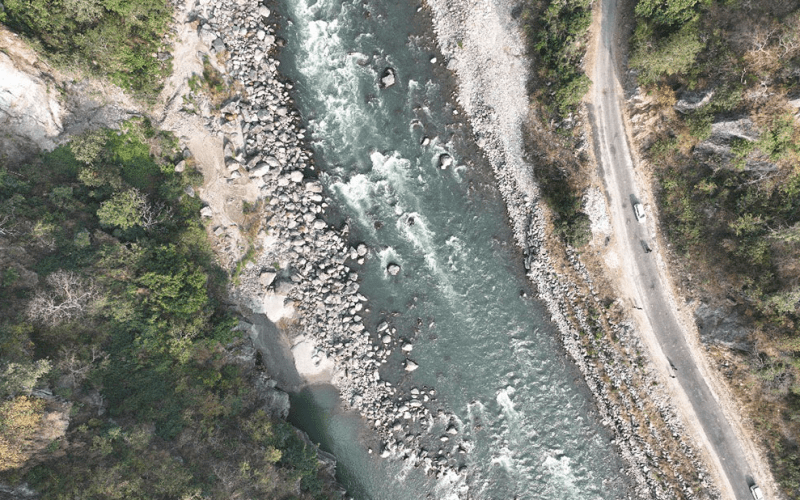
Situated on the Kurichhu River, the Dorjilung project spans the districts of Mongar and Lhuentse. The design features a 139.5-metre concrete gravity dam that will channel nearly 287 m³/s of water through a 15-kilometre headrace tunnel to an underground powerhouse housing six Francis turbines. Once complete, it is expected to generate around 4.5 terawatt-hours annually.
The total project cost is estimated at US$1.7 billion (approximately Nu/₹150 billion), with initial infrastructure works valued at around Nu/₹500 million. Financing is being provided by the World Bank.
DGPC Managing Director Dasho Chhewang Rinzin described the launch as a significant step for Mongar and Lhuentse, noting that tenders for major civil works — including the dam, boreholes, and tunnels — will be issued soon. He also revealed ongoing discussions with Tata Power for a 500 MW solar power agreement linked to the Dorjilung project.
A Strategic Energy Alliance
Tata Power’s partnership with DGPC was formalised last November, aiming to develop at least 5,000 MW of clean energy capacity in Bhutan. This includes hydropower ventures such as Dorjilung (1,125 MW), Gongri Reservoir (740 MW), Jeri Pumped Storage (1,800 MW), and Chamkharchhu IV (364 MW), alongside 500 MW of solar capacity through Tata Power Renewable Energy Limited.
The Indian firm had earlier acquired a 40 percent stake in Bhutan’s 600 MW Khorlochhu Hydroelectric Project for Nu/₹8.30 billion, marking a major private-sector investment in the country’s hydropower sector.
Tata Power CEO Praveer Sinha hailed the Dorjilung partnership as a “new energy era” for the region, citing the project’s role in meeting both countries’ growing energy demands with round-the-clock clean power.
A Shift in Development Model
Observers note that Dorjilung is distinctive not just for its scale, but for its financing structure. K. Yhome, a fellow at the Shillong-based think tank Asian Confluence, told ETV Bharat that Bhutan is increasingly seeking investment over traditional aid and credit lines, reducing dependency on any single partner.
“This is more of a business-to-business arrangement,” Yhome said, adding that such a model allows for greater parity and independence in decision-making.
The project also aligns with Bhutan’s long-standing hydropower cooperation with India, formalised under a 2006 agreement and its 2009 protocol. Four joint hydro projects totalling 2,136 MW are already operational, with others such as Punatsangchhu-I and II under construction.
Symbol of Regional Cooperation
As one of Bhutan’s largest hydropower undertakings, Dorjilung stands to strengthen economic ties with India while bolstering the kingdom’s renewable energy portfolio. Its mix of public and private involvement, international financing, and cutting-edge design underscores a broader shift in how Bhutan harnesses its vast hydropower potential — not just for export, but for economic transformation at home.


