


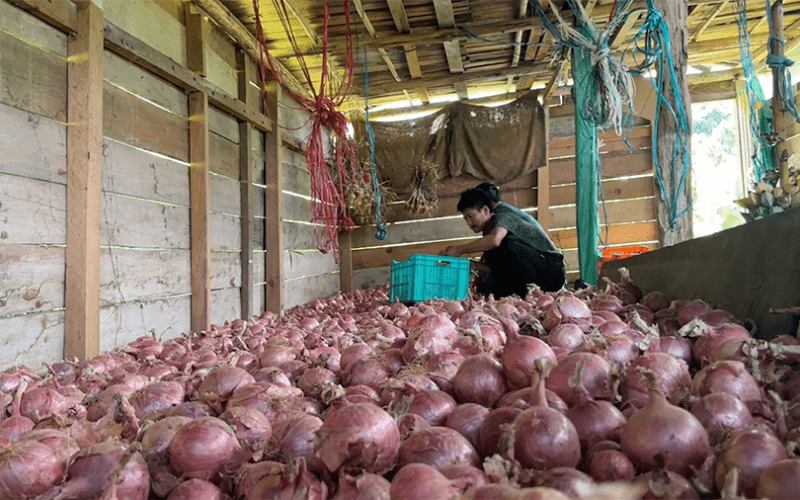
In the quiet hills of Kalapang in Saling Gewog, a quiet agricultural revolution is taking root—one bulb at a time. Onion, a kitchen staple with steady demand across Bhutan, is fast becoming the new cash crop for local farmers, thanks to a high-yielding variety introduced by the Agriculture Research and Development Centre (ARDC) in Wengkhar.
Leading this change is 29-year-old Sonam Gyeltshen, a young and enterprising farmer from Kalapang, who has embraced commercial onion cultivation with impressive results. Working alongside his wife, Sonam recently harvested over two metric tonnes (2,000 kg) of onions from a one-acre plot. Carefully sorted and packed, the onions are supplied weekly to the Gyalsung Academy and sold at Nu 60 per kilogramme.
“With three bulbs sometimes weighing more than a kilogramme, the yield and quality are excellent,” Sonam shared, as he neatly stacked over 1,000 kg of his latest harvest. “We used to earn just Nu 20,000 to 30,000 in a season with small-scale cultivation. This year, I’m hoping to earn over Nu 100,000.”
Sonam’s enthusiasm is shared by five other farmers in Kalapang who have also shifted to large-scale onion farming. The support from ARDC Wengkhar has been instrumental in this transformation. Under a cost-sharing scheme supported by the Commercial Agriculture and Resilient Livelihoods Enhancement Programme (CARLEP), nearly 1,500 packets of bulb onion seeds were distributed to around 360 households in Monggar.
According to officials at ARDC Wengkhar, nearly 60 metric tonnes of onions have been harvested from 14 villages in the region this year, with Kalapang alone recording an impressive yield of nine metric tonnes per acre—the highest among the villages.
Sonam believes local production can play a crucial role in reducing dependence on imported onions, especially during monsoon seasons when Indian supply dwindles and prices soar.
“If we rely on Indian onions, prices can go up to Nu 150 per kilogramme during the monsoon. But we can grow them here, with the same quality,” he said. “The problem is, many young people don’t stay in the villages, and it’s mostly elderly who are left behind—they struggle with the work.”
With nearby towns like Gyalposhing and Lingmithang offering accessible markets, Kalapang’s onion farmers are optimistic about the future. The high-yielding onion variety and strong demand could well turn this humble crop into a sustainable livelihood option for Bhutanese farmers.
As Sonam Gyeltshen and his peers demonstrate, with the right support and motivation, rural communities can thrive—one onion harvest at a time.


