


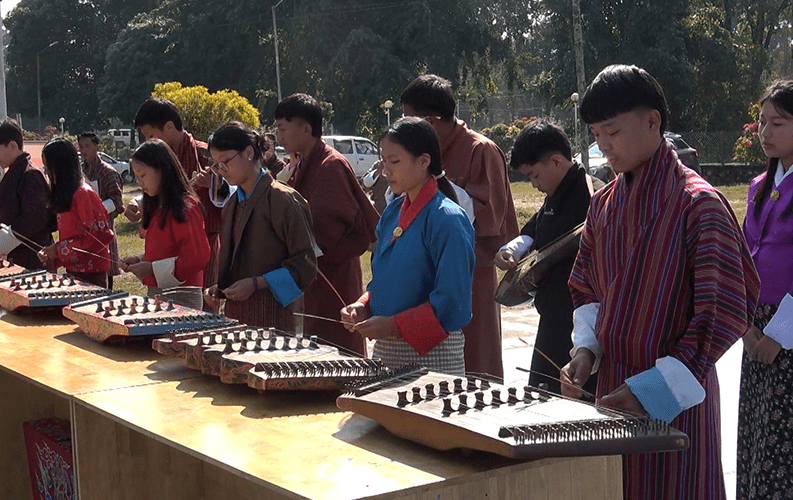
For decades, Bhutan’s traditional music and arts have been celebrated as pillars of the nation’s identity, yet for many young people, learning them has remained out of reach. This winter, that gap narrowed in Gelephu, where an intensive cultural programme brought traditional melodies, movements and crafts directly into the hands of students.
Around 60 young participants took part in the latest edition of the Engaging Youth in Living Heritage programme, an initiative designed to introduce Bhutanese youth to traditional music, instruments and other forms of cultural expression. For many, it was their first opportunity to learn from trained instructors using authentic instruments and materials.
Among the participants was 17-year-old Cheki Wangdi from Zhemgang, a student of Pelrithang Higher Secondary School. His fascination with Bhutanese music began years ago, but for a long time it remained a distant aspiration.
“Before, learning traditional music felt impossible,” Cheki said. “There were no instruments, no teachers, and nowhere to practise.”
That changed when he joined similar engagement programmes during school vacations. Since 2021, he has returned whenever possible, dedicating much of his winter and summer breaks to music. Today, Cheki confidently plays instruments such as the dramngyen, lim and yangchen, his progress reflecting years of quiet determination.
He credits the programme for making that journey possible. “As someone who loves music, it is very difficult to learn without proper guidance,” he said. “These programmes help us learn and preserve our culture at the same time.”
Cheki’s experience mirrors that of many others in Gelephu. For Ngawang Choki, a Class Ten student from Gelephu Higher Secondary School, the programme offered her first real chance to learn the yangchen, an instrument she had admired from afar.
Within just ten days, Ngawang learned the fundamentals and now plays with visible confidence. “I always wanted to learn, but I didn’t have anyone to teach me,” she said. “Now that I know a little, I want to pass it on to others so our culture continues.”
The programme extends far beyond music. Students were also introduced to traditional dance and songs, painting, sculpting, xylography, paper preservation and calligraphy, offering a broad exploration of Bhutan’s living heritage.
Another participant, Karma Yangzom from Gelephu Higher Secondary School, said the lessons went deeper than performance alone. “Through Boedra singing and dancing, I learned not only the movements and dress, but also the history and origins of the songs,” she said. “I would love to join again.”
Organisers say such depth is often missing from cultural activities in schools. According to programme coordinator Yeshi Lhendup, while some institutions offer cultural sessions, they are frequently limited in scope.
“Here, we teach the basics in detail,” he explained. “In music, for example, we teach note scales like do, re, mi, fa, so, la, ti—things that are usually not covered in schools.”
Now in its fifth edition, the Engaging Youth in Living Heritage programme has reached more than 600 students during winter and summer breaks across the country. Organisers plan to expand it further, adding more art forms and bringing the initiative to additional districts.
The programme in Gelephu concluded this week, but for the students involved, its impact is likely to resonate long after the final notes faded. In their hands, Bhutan’s traditions are no longer distant echoes, but living skills—learnt, practised and ready to be carried forward.


