


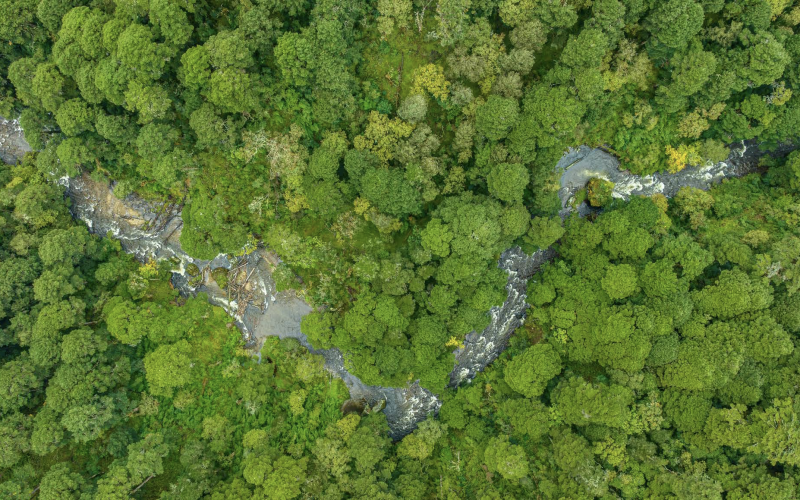
More than 70 percent of the Himalayan kingdom remains under forest cover, making Bhutan one of the most densely forested countries in the world. The country’s constitution requires that at least 60 percent of the land remain forested for all time — a legal commitment unmatched anywhere else. Bhutan is also carbon negative, absorbing more carbon dioxide than it emits, thanks to its forests and hydropower-based energy system. These facts are often cited. What is less discussed is how deeply ecology shapes daily life, travel, and governance here.
Driving across Bhutan feels like moving through a living archive of ecosystems. Subtropical forests in the south give way to temperate broadleaf woodlands, alpine meadows, and snow-bound peaks above 7,000 metres. Within this compact geography lie more than 5,400 species of plants, nearly 200 species of mammals, and over 700 bird species.

Tigers roam protected corridors that stretch from India’s lowlands to high mountain passes. Snow leopards share territory with yak herders. The continuity of habitat is not accidental. Bhutan has designated more than half its land as protected areas, linked by biological corridors that allow wildlife to move freely.
In Bhutan, nature is not a backdrop. It is a constitutional mandate.
For travellers, this ecological integrity is immediately tangible. There are no billboard-scarred highways, no mega-resorts on fragile ridgelines. Tourism is regulated through a daily Sustainable Development Fee, designed to limit numbers and fund conservation, healthcare, education, and infrastructure. This model has been debated, adjusted, and refined, but its principle remains clear: tourism must serve national well-being, not overwhelm it.
What does responsible travel look like in Bhutan? It begins with slowness. Trekking routes such as the Druk Path or Jomolhari trails are carefully managed, with strict waste policies and pack-in, pack-out systems. Visitors often travel with local guides who are trained not only in navigation but in ecological interpretation — explaining medicinal plants, animal tracks, and sacred landscapes where Buddhism and ecology intersect.

Beyond trekking, travellers can experience conservation in action. In Phobjikha, a glacial valley that serves as winter habitat for the endangered black-necked crane, power lines are buried underground to protect the birds. In Bumthang and Haa, community forests are managed by villagers who decide how much wood can be harvested and where grazing is permitted. These are not museum landscapes; they are working ecosystems.
Bhutan’s environmental philosophy is inseparable from its development model of Gross National Happiness, which measures progress through cultural preservation, environmental conservation, good governance, and equitable growth. This does not mean Bhutan is untouched by climate change. Glacial lake outburst floods, shifting rainfall patterns, and biodiversity pressures are real and growing threats. But the country confronts these challenges with an unusual degree of coherence, investing in climate resilience, disaster preparedness, and renewable energy.
For the traveller, Bhutan offers something increasingly rare: a place where ecological values are not curated for visitors but lived daily. To walk through its forests is to witness a nation that has chosen restraint over extraction, continuity over convenience. In an era of ecological loss, Bhutan does not promise perfection — but it offers proof that another path is possible.


